 Written and reviewed by Josh Kohanim, Esq., California Bar No. 328609 · Reviewed
Local differences in Orange County
This page is for anyone in Orange County living with a head injury from a crash or a fall, and for the family helping them. It covers how a concussion or other traumatic brain injury is documented and proved, damages and future care, insurance, the county's trauma centers, deadlines, public agency claims and the courthouse. Local details were checked on each agency's website on November 9, 2026, and the medical information comes from National Institutes of Health pages opened that day.
Symptoms and the medical record
A brain injury claim rests on a medical record built over time. The National Institute of Child Health and Human Development (NICHD), part of the National Institutes of Health, says some symptoms of a traumatic brain injury (TBI) appear right away, while others may appear several days or even weeks later and change over time, and that a person with a TBI may or may not lose consciousness. Its list of mild TBI symptoms includes headache, dizziness, blurred vision, ringing in the ears, changed sleep, mood changes, sensitivity to light or sound, and trouble with memory, concentration or thinking (NICHD, TBI symptoms). NICHD advises anyone who takes a blow to the head to seek medical attention even if none of those symptoms appear. Tell each provider when each symptom began. Our concussion symptom tracker keeps a daily record to bring to appointments.
Scans and their limits
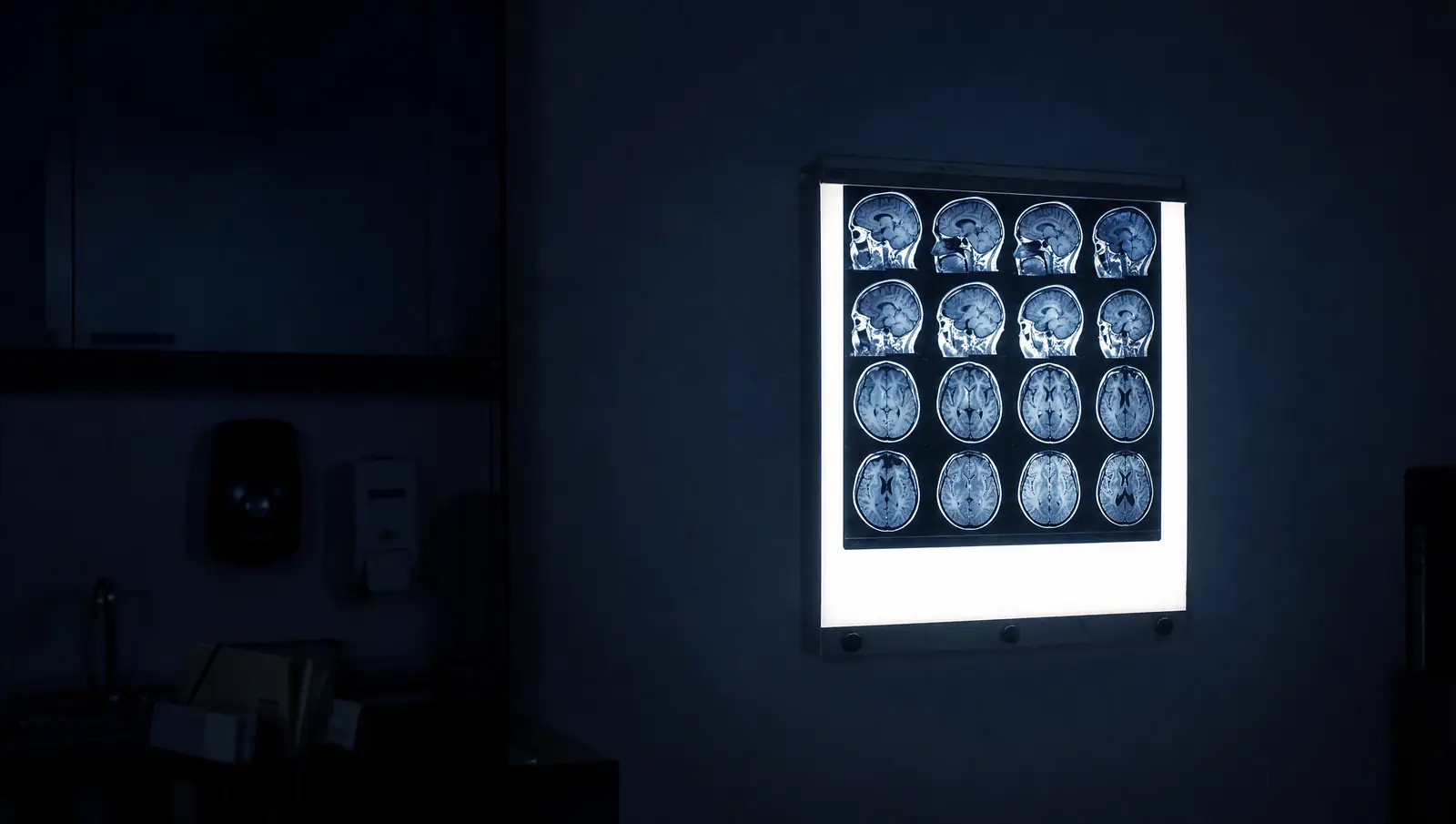
NICHD describes a CT scan as a quick way to show whether the brain is bleeding or bruised or has other damage. MRI produces more detailed images; NICHD says it likely would not be part of the first assessment, because it takes too long, but may be used in follow-up. NICHD also describes a blood test, approved by the Food and Drug Administration in 2018, that can help identify people whose injury is unlikely to show up on a CT scan (NICHD, diagnosing TBI, reviewed December 26, 2025). So a normal CT scan answers whether there is bleeding or bruising that needs care now; by itself, it does not rule out a mild brain injury. The emergency record also carries a Glasgow Coma Scale score, rating speech, eye opening and movement; NICHD says 13 or higher indicates a mild TBI, sometimes called a concussion.
Testing and witnesses
Beyond imaging, NICHD lists cognition tests of thinking, reasoning, problem solving, understanding and remembering, and neuropsychological assessments of brain and social functions, including the ability to control one's behavior and actions. In a claim, those results, the treating doctors' notes over the following months, and people who knew you before the injury and can say what changed carry the proof a scan cannot. If there is a gap in treatment, the reason for it should be in writing. Our guides on proving a mild TBI and concussion after a car accident explain each piece.
Damages in a brain injury claim
California measures damages for an injury as the amount that will compensate for all the detriment proximately caused, whether it could have been anticipated or not (Civil Code section 3333), and damages may be awarded for detriment certain to result in the future (Civil Code section 3283). To recover future medical expenses, the injured person must prove the reasonable cost of reasonably necessary care they are reasonably certain to need (CACI No. 3903A, 2026 edition). Lost earning capacity is the loss of the ability to earn money, and a work history is not required to claim it (CACI No. 3903D). For pain, mental suffering and loss of enjoyment of life, no fixed standard exists: the jury decides a reasonable amount in current dollars, and the instruction says not to reduce it further to present cash value (CACI No. 3905A).
Future care and rehabilitation
NICHD says rehabilitation after a TBI can include physical, occupational, speech and cognitive therapy, psychological counseling and vocational counseling, and that, depending on the injury, these treatments may be needed only briefly, occasionally throughout a person's life, or on an ongoing basis (NICHD, TBI treatments). For a serious injury, we work with the treating doctors, and where needed a life care planner, to set out each item of future care with its cost. Our guide to brain injury damages and future care explains how each category is built.
Earlier injuries and conditions
An earlier concussion or another condition does not by itself end a claim. The jury must decide the full amount that will fairly compensate the injured person for all damages the defendant caused, even if that person was more susceptible to injury than a normally healthy person would have been (CACI No. 3928). No damages are awarded for a condition that existed before, but if the defendant's conduct made it worse, the jury must award damages for the effect on that condition (CACI No. 3927). We gather the earlier records at the start, so the before and after are clear.
Insurance after a crash
When another driver caused the crash, the claim is made against that driver's liability insurance, up to its limits. California's minimum auto liability coverage is $30,000 for the injury or death of one person and $60,000 for everyone hurt or killed in one crash, plus $15,000 for property damage, for policies issued or renewed on or after January 1, 2025 (Vehicle Code 16056). A policy issued before then kept the old $15,000 and $30,000 limits until it renewed. A California auto policy with bodily injury liability coverage includes uninsured and underinsured motorist coverage unless the policyholder deleted or reduced it in writing. Umbrella and excess policies do not have to include it. Insurers must offer UM at your bodily injury limits up to $30,000 per person and $60,000 per accident (Insurance Code section 11580.2).
Underinsured drivers
Underinsured motorist coverage applies when the other driver's limits are lower than your own uninsured motorist limits, and it is reduced by amounts paid by or for anyone who may be legally liable, such as that driver's insurer. The uninsured motorist claim has its own deadline: within two years of the crash, you must sue the uninsured driver, reach a written agreement with your insurer, or start arbitration by certified mail. Our auto policy checklist shows where to find your coverage.
Trauma centers in Orange County
Orange County EMS lists four trauma centers in the county: UCI Health in Orange, Orange County Global Medical Center in Santa Ana, Mission Hospital in Mission Viejo, and Rady Children's Hospital Orange County for children. Long Beach Memorial Medical Center in Los Angeles County is also on its list (OCEMS Policies 240.10, effective January 1, 2026, and 240.30, effective June 1, 2026, checked November 9, 2026). UCI Health in Orange is the county's only Level I adult trauma center on the state's list. Orange County Global Medical Center and Mission Hospital are Level II (California EMS Authority, Designated Trauma Centers, updated August 25, 2025). If you were treated at one of them, we request the complete chart, including the imaging and the trauma notes, not only the discharge summary.
Deadlines for a brain injury claim
Most California injury lawsuits must be filed within two years of the injury (Code of Civil Procedure section 335.1). If a city, a county, the State, a school district, a transit agency or another public entity may be responsible, a written claim must first be presented to that entity within six months after the claim accrues (Government Code section 911.2). The lawsuit against the entity then has its own deadline: six months after a written rejection notice is delivered or mailed, or two years from the date the claim accrued if no written notice is given (Government Code section 945.6). The dates in any one case should be calculated by a lawyer.
Our deadline calculator sets out these dates. The uninsured motorist deadline runs separately, from the date of the crash.
Claims against a public agency
The claim goes to the public entity whose employee, vehicle or property was involved, such as a county vehicle, a transit bus or a fall on public property. A claim against the County of Orange is made on the county's Claim for Money or Damages form and mailed or delivered to the Clerk of the Board of Supervisors, 400 W. Civic Center Drive, 6th Floor, Santa Ana, CA 92701 (County of Orange claim form, Revised 1/24, checked November 9, 2026). If the six months pass, a late claim application may be made within one year under Government Code section 911.4, and it is not granted automatically.
| What was involved | Who receives the claim | Where it goes |
|---|---|---|
| A County of Orange vehicle, employee or property | The County of Orange | The Clerk of the Board of Supervisors, 400 W. Civic Center Drive, 6th Floor, Santa Ana, by mail or delivery |
| A city's vehicle, employee or property | That city | That city's claim office; in Santa Ana, the City Clerk's Office |
| A state highway, a Caltrans vehicle or another state agency | The State of California | The Department of General Services, Government Claims Program, with a $25 filing fee |
| A school district or a public transit agency | That district or agency | That entity, within the same six months |
A claim against the State goes to the Department of General Services, whose claim page states the $25 fee.
Serious and fatal injuries
In 2024, 209 people were killed in traffic crashes in Orange County, 1,112 were killed or seriously injured, and 17,992 were killed or injured (SWITRS via UC Berkeley TIMS, data as of September 15, 2026; 2025 provisional). When an injury proves fatal, the family's claim is a wrongful death claim, and most California wrongful death lawsuits must be filed within two years of the date of death (Code of Civil Procedure section 335.1). The Orange County Sheriff-Coroner investigates accidental deaths countywide from its facility at 1071 W. Santa Ana Blvd. in Santa Ana (OC Sheriff-Coroner pages, checked November 9, 2026). Our Orange County wrongful death lawyer page covers the Coroner, death certificates and the family's deadlines. Year-by-year counts for every California city, from the federal FARS data, are in our fatal crash facts by city tool.
The Orange County courthouse
Orange County Superior Court hears unlimited civil, limited civil and small claims cases for every city in the county at the Central Justice Center, 700 Civic Center Drive West, Santa Ana. Complex civil cases go to the Civil Complex Center, 751 West Santa Ana Blvd. A dispute of $35,000 or less is a limited civil case (Orange County Superior Court location and civil pages, checked November 9, 2026). If a lawsuit is needed, we file it, and you do not have to go to the courthouse to start the case.
Our work on your claim
We gather the paramedic, emergency and trauma records, the imaging and every follow-up chart, ask the agency that responded for the collision report, and check early whether a public agency was involved so any claim is presented on time. We deal with the insurance companies, including any request for a recorded statement, so you can focus on treatment. We look for every policy that may apply, including your own underinsured motorist coverage. What a claim is worth depends on its own facts, and no result is guaranteed. We meet by phone or video, in English or Spanish, and nobody has to drive to our Tarzana office. The rest of the process is on our brain injury lawyer page.
Related brain injury pages
If the injury happened in Santa Ana, our Santa Ana brain injury lawyer page covers the city's police reports and claims against the City of Santa Ana. In Ventura County, see our Thousand Oaks brain injury lawyer page. When the injuries go beyond the head, see our Orange County catastrophic injury page, and for the crash itself, our Orange County car accident page. The county as a whole is on our Orange County personal injury lawyer page.
Sources cited
- National Institute of Child Health and Human Development (NIH), traumatic brain injury: symptoms, diagnosis and treatments
- Civil Code sections 3283 and 3333: 3283 and 3333
- Judicial Council of California Civil Jury Instructions (2026 edition), CACI Nos. 3903A, 3903D, 3905A, 3927 and 3928: courts.ca.gov (PDF)
- Vehicle Code section 16056 and Insurance Code section 11580.2: 16056 and 11580.2
- Code of Civil Procedure section 335.1: California Legislative Information
- Government Code sections 911.2, 911.4 and 945.6: 911.2, 911.4 and 945.6
- Orange County EMS, Policies 240.10 and 240.30: 240.10 (PDF) and 240.30 (PDF)
- California EMS Authority, Designated Trauma Centers, updated August 25, 2025: emsa.ca.gov (PDF)
- County of Orange, Claim for Money or Damages (Revised 1/24): claim form (PDF)
- Department of General Services, File a Claim: dgs.ca.gov
- SWITRS via UC Berkeley TIMS, data as of September 15, 2026: tims.berkeley.edu
- Orange County Sheriff's Department, Coroner Division FAQs: ocsheriff.gov
- Superior Court of California, County of Orange: Central Justice Center and Civil Division