 Written and reviewed by Josh Kohanim, Esq., California Bar No. 328609 · Published · Reviewed
Quick questions
Commercial vehicle cases
This page is for people hurt in Los Angeles County by a vehicle driven for a business or public agency, and for families of people killed in one. It covers who may be responsible, the records, the insurance and the deadlines. It does not cover claims by the employee driver, cargo damage, or big-rig rules in depth, which our Los Angeles truck accident lawyer page explains.
Respondeat superior is the rule that makes an employer answer for an employee's negligence, meaning a failure to use reasonable care, on the job. Civil Code section 2338 makes a principal responsible "for the negligence of his agent in the transaction of the business of the agency." The same truck can be a company case at 2 p.m. and a personal one at midnight.
We work through each case in this order:
- What happened, from the report, video and witnesses.
- Which business stood behind the driver.
- Who may be responsible, and on what theory.
- What records exist, and how long they must be kept.
- Which insurance applies, and in what order.
- How serious the injury is, by the medical record.
- What you or your family can do next, and by when.
Vehicle classes and rules
Federal safety rules apply to a commercial motor vehicle: under 49 CFR 390.5T, one used in interstate commerce that is rated at or weighs 10,001 pounds or more, carries more than 8 passengers for pay or 15 without pay, or hauls placarded hazardous materials. Most cargo vans sit under that line.
| Vehicle | License | Federal rules | California rules | Insurance floor |
|---|---|---|---|---|
| Van or pickup under 10,001 lb | Class C | Not a commercial vehicle | Permit only if it hauls for pay | $30,000 per person; $300,000 if for hire |
| Two-axle box truck, 10,001 to 26,000 lb | Class C | Safety rules if interstate; no CDL | CHP rules and a carrier permit | $750,000 |
| Heavy truck, 26,001 lb and up | Class B | CDL and drug testing | CHP rules and 90-day inspections | $750,000 |
| Tractor-trailer | Class A | CDL and drug testing | CHP rules and 90-day inspections | $750,000; more for hazardous loads |
Class C covers a two-axle vehicle up to 26,000 pounds, and three axles need Class B (Vehicle Code section 12804.9). A CDL, the commercial driver's license, starts at 26,001 pounds (49 CFR 383.5), and federal drug testing reaches only CDL drivers (49 CFR 382.103). CHP authority and permit minimums come from Vehicle Code sections 34500 and 34631.5. The federal $750,000 floor (49 CFR 387.9) covers for-hire interstate freight carriers, not every commercial vehicle.
A trip between two California points is interstate commerce when it is part of a shipment that began or will end outside the state, such as an imported container (49 CFR 390.5T). California limits intrastate truck drivers to 12 hours of driving and 80 hours in 8 days (13 CCR 1212.5), with electronic logging devices required since January 1, 2024 (13 CCR 1213).
Responsible companies
Several businesses can stand behind one vehicle, and each answers only if the facts fit a rule.
| Who | When they may answer | What decides it |
|---|---|---|
| Driver | Careless driving | Report, video, witnesses |
| Employer | The driver was doing the job | Dispatch, trip purpose |
| Employer, directly | It let an unfit driver drive | License, driving history |
| A motor carrier | It used a contractor driver | Operating authority, the lease |
| The vehicle's owner | It gave permission to drive | Registration, permission |
| A rental company | Its own negligence only | Maintenance records |
| A delivery network | It controlled the driver's work | Routing, cameras, contracts |
| A freight broker | It chose an unsafe carrier | The carrier's safety record |
| A shipper or loader | Unsettled in California | Who loaded the cargo |
| A repair shop | It repaired or inspected badly | Work orders |
| A public agency | Its employee was on the job | Six-month claim rules |
The employer question is the scope of employment: whether the driver was doing the job. Under the going-and-coming rule a commute is usually personal, even for a hybrid worker (Chang v. Southern California Permanente Medical Group, 2026). Exceptions bring the drive back in. An employee required to use her own car for work stayed within the job on her way home, even turning into a frozen yogurt shop (Moradi v. Marsh USA, 2013). A paid commute counts (Hinman v. Westinghouse, 1970), and so does a business errand (Jeewarat v. Warner Bros., 2009).
A company can also be careless itself; Vehicle Code section 14606 bars letting anyone drive without the right license class. If the employer admits responsibility for its driver, separate hiring and entrustment claims drop out (Diaz v. Carcamo, 2011), but punitive damages, meant to punish, remain possible (CRST v. Superior Court, 2017) if an officer, director or managing agent knowingly kept an unfit driver in conscious disregard of safety, or authorized or ratified the conduct (Civil Code section 3294(b)).
A contractor label does not end the question: a regulated carrier answers for its contractor's negligence (Serna v. Pettey Leach Trucking, 2003), and the AB 5 test in Labor Code section 2775 governs only labor, unemployment and wage-order law. An owner who lends a vehicle is liable under Vehicle Code section 17150, capped at $15,000 per person by section 17151 unless the driver was its employee or agent. A rental company answers only for its own negligence (49 U.S.C. 30106; Tavares v. Zipcar, 2026), and a repair shop for a repair or inspection it did badly (Seo v. All-Makes Overhead Doors, 2002).
A broker that carelessly picks an unsafe carrier can be sued after Montgomery v. Caribe Transport II (U.S. 2026), though a concurrence said reasonable brokers should be able to defend. For shippers and receivers, Casarez v. Irigoyen Farms (Cal. Ct. App. 2025) held federal law preempts the claims; a Supreme Court petition is pending. Our guides on suing the company and who is liable in a truck accident go further.
Company records and data
From the first day, a business that runs vehicles has an insurer or claims administrator, an adjuster, often a safety manager, lawyers for serious claims, and systems that recorded the trip: dispatch, GPS, telematics and often cameras. That is a fact, not a reason to rush. What matters is naming the records in writing, because some retention periods are short.
| Record | Required retention | Rule |
|---|---|---|
| Driver logs | 6 months | 49 CFR 395.8(k)(1) |
| Inspection reports | 3 months | 49 CFR 396.11 |
| Maintenance records | 1 year, plus 6 months after the vehicle leaves | 49 CFR 396.3(c) |
| Driver qualification file | Employment plus 3 years | 49 CFR 391.51 |
| Accident register | 3 years | 49 CFR 390.15 |
| California 90-day inspections | 2 years | Vehicle Code 34505.5 |
| Engine data, telematics, video | No rule | Vendor settings |
Sources: 49 CFR 395.8, 396.11, 396.3, 391.51, 390.15 and Vehicle Code section 34505.5. A fleet of light vans may have no retention rule at all.
After a fatal crash, a CDL driver's employer must test for alcohol and drugs; after an injury treated away from the scene or a tow-away, only if the driver is cited (49 CFR 382.303). An event data recorder generally can be downloaded only with the owner's consent or a court order (Vehicle Code section 9951). Amazon's camera notice says van footage that is not uploaded "is automatically overwritten" (Amazon).
A preservation letter names the records a company must keep for a claim. See our evidence guide and our find the company behind the vehicle tool.
Insurance behind the company
Policy limits are the most a policy will pay. A California auto policy issued or renewed since January 1, 2025 must carry $30,000 per person and $60,000 per crash (Vehicle Code section 16056). A motor carrier permit requires $750,000, or $300,000 for a fleet of only vehicles under 10,000 pounds (Vehicle Code section 34631.5). App delivery companies must carry $1,000,000 for engaged-time crashes not otherwise covered (Business and Professions Code section 7455).
Which policy pays depends on who owned the vehicle, who drove, and why; when coverage runs short, see when insurance is not enough.
For federally regulated carriers, the MCS-90 endorsement makes the insurer pay a final judgment up to the federal minimum "regardless of whether or not each motor vehicle is specifically described in the policy," with the carrier repaying the insurer (Form MCS-90). A carrier may self-insure with federal approval (49 CFR 387.309), and its proof of coverage is public on reasonable request (49 CFR 387.7).
Your own uninsured and underinsured motorist coverage, which pays when the other side has none or too little, is the backstop, except that a government vehicle is not "uninsured" under Insurance Code section 11580.2. Our guide on whose insurance pays maps each case.
Delivery vans and networks
A branded van tells you whose packages it carries, not always who employs the driver.
| Network | Who drives | What to know |
|---|---|---|
| Amazon van | Employee of a separate delivery company | Amazon designs suggested routes and can ground vans |
| Amazon Flex | Contractor in a personal car | Amazon states a $1,000,000 policy while delivering |
| FedEx | Employee courier or a contractor's driver | Varies market by market |
| UPS | Union employee, including seasonal drivers | No inward-facing cameras |
| USPS | Federal employee, or a mail contractor | Federal claim within 2 years; contractors differ |
| OnTrac | Driver for an independent delivery company | Partners carry their own insurance |
| DHL eCommerce | USPS makes the final delivery | USPS rules apply |
| Food and grocery apps | Usually a contractor under Prop 22 | $1,000,000 during engaged time |
Sources: Amazon's letter to Senator Murphy, Amazon Flex, FedEx's 2026 annual report, the UPS Teamsters agreement, OnTrac, USPS, 28 U.S.C. 2671 and Prop 22.
Amazon says it is not the employer of its Delivery Service Partners' drivers, and we have found no published appellate decision holding Amazon responsible for a DSP or Flex driver's crash. Juries elsewhere have ruled on specific facts: $44.6 million, including $30 million in punitive damages, in South Carolina in 2023 (ABC News 4); $16.2 million in Georgia in 2024, with 85 percent of the fault on Amazon (CVN); and $56 million in Massachusetts in 2026 after Amazon stipulated to liability (CVN). Control decides it: who set the route, watched the driver and could ground the van.
Preservation requests go to the delivery company and to Amazon. See our Amazon delivery van guide and our delivery truck and last mile guide.
Box trucks and work trucks
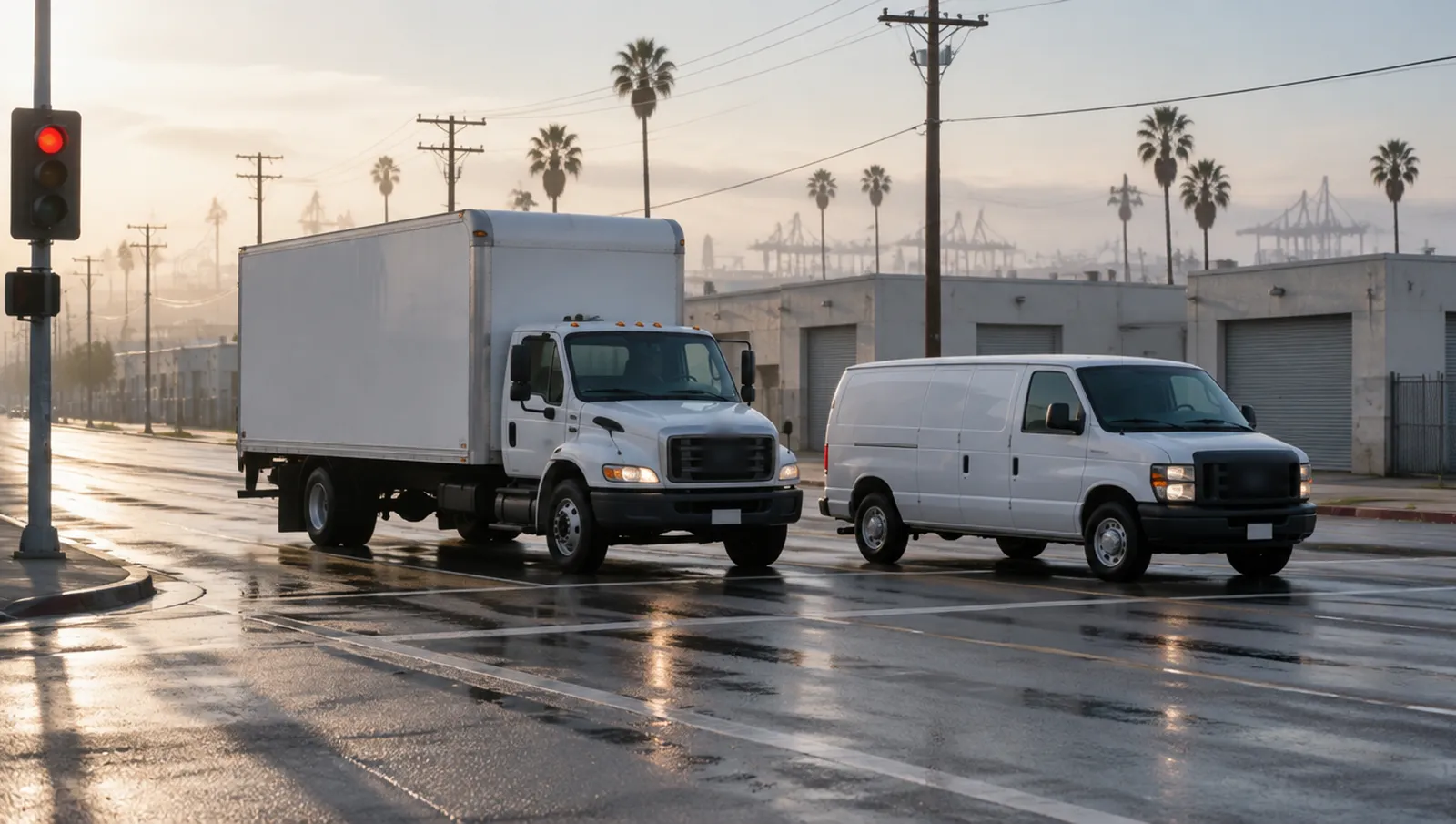
A two-axle box truck up to 26,000 pounds needs only a Class C license, so its driver has no CDL and no federal drug testing. California still treats a two-axle truck over 10,000 pounds used in business as a commercial vehicle (Vehicle Code section 34601) whose carrier needs a permit (section 34620) and $750,000 in coverage.
A truck rented for 30 days or less may show the rental company's name and USDOT number instead of the operator's (49 CFR 390.21T); the renter is named in the rental agreement. A person moving their own household is not operating commercially (49 CFR 390.3T).
A three-axle dump truck or cement mixer needs a Class B license even under 26,000 pounds. Garbage trucks split by owner: a City of Los Angeles sanitation truck is a City vehicle with a six-month claim, while the six recycLA haulers serving commercial and larger apartment properties, including Athens, Republic and WM, are private companies under the two-year rule (LA Sanitation). See our box truck guide and our truck accident page.
Government vehicles
Public entities include the state, counties, cities, districts and public authorities (Government Code section 811.2): in Los Angeles, LA Metro (Public Utilities Code section 130050.2), City departments, LAUSD and the County. The agency is liable for its employee's negligent driving on the job (Vehicle Code section 17001), has 45 days to act on the claim (section 912.4), and after a written rejection the suit must follow within six months (section 945.6).
A Postal Service or other federal vehicle follows the Federal Tort Claims Act: a written claim for a specific dollar amount within two years (28 U.S.C. 2401(b); 39 CFR Part 912), a judge rather than a jury (28 U.S.C. 2402), no punitive damages (2674), and attorney fees capped at 20 or 25 percent (2678). See our government and postal vehicle guide and our post on LA Metro bus claims.
Deaths in commercial crashes
When a commercial vehicle kills someone, the surviving spouse or domestic partner, the children and others listed in Code of Civil Procedure section 377.60 may bring a wrongful death claim for their own losses. A survival action carries the claim of the person who died; one filed in 2026 cannot include pre-death pain and suffering but can include economic losses and punitive damages (section 377.34).
A death requires post-crash testing of a CDL driver (49 CFR 382.303). A CHP Multidisciplinary Accident Investigation Team, which includes a Motor Carrier Specialist who inspects the vehicles, handles major collisions, not every fatal crash (CHP).
See our fatal commercial vehicle crash guide, who can file, survival actions, the first 48 hours checklist and our wrongful death page.
Commercial crashes in Los Angeles
Caltrans's 2024 count file puts California's highest truck count on SR-60 at Nogales Street in Rowland Heights, at 53,106 trucks a day, and 75 of the state's 100 highest rows in Los Angeles, Riverside, San Bernardino and Orange counties (Caltrans). Truck shares are Caltrans estimates, some set years ago.
| Count point | County | Trucks a day | Truck share | Share year |
|---|---|---|---|---|
| SR-60 at Nogales St | Los Angeles | 53,106 | 22.2% | 2017 |
| SR-60 at Archibald Ave | San Bernardino | 33,352 | 15.2% | 2022 |
| I-710 at Del Amo Blvd | Los Angeles | 31,968 | 17.8% | 2021 |
| I-10 at Etiwanda Ave | San Bernardino | 26,778 | 14.0% | 2021 |
| I-10 at Cherry Ave | San Bernardino | 26,587 | 13.9% | 2022 |
| I-15 at I-10 | San Bernardino | 21,839 | 10.4% | 2006 |
| I-405 north of Sherman Way | Los Angeles | 14,796 | 6.9% | 2022 |
LA Metro says the I-710 carries "nearly 40,000 heavy-duty trucks" a day (LA Metro).
- 62Deaths in large-truck crashes, Los Angeles County, 2024NHTSA FARS 2024
- 27 of 61Fatal county truck crashes off interstate, U.S. and state highwaysNHTSA FARS 2024
- 65Deaths in San Bernardino and Riverside counties combinedNHTSA FARS 2024
- 394Deaths in large-truck crashes statewideNHTSA FARS 2024
Those are our counts from NHTSA's 2024 Fatality Analysis Reporting System file, using NHTSA's large-truck body types (FARS 2024). Los Angeles County had 61 such crashes and 62 deaths: 16 on interstates, 11 on state highways, 4 on U.S. highways, 27 on other roads and 3 unrecorded, with 7 on SR-138 or Sierra Highway in the north county. For the 65 deaths in San Bernardino and Riverside counties, see our Inland Empire truck accident page.
A MAIT team assigned in Los Angeles comes from the CHP's Southern Division. Since January 8, 2024, Central District injury cases go to independent calendar courtrooms at the Stanley Mosk Courthouse, not the former Spring Street hub (LA Superior Court).
The Port of Los Angeles handled 10,239,318 TEUs, twenty-foot container units, in 2025 (Port of Los Angeles), and the Port of Long Beach a record 9,881,595 (Container News). Every truck entering a terminal must be on the Port Drayage Truck Registry (Clean Truck Program); see our port and drayage guide.
Case value
A commercial vehicle claim is valued from the medical record, future care, lost earnings, the harm a jury would weigh, and the coverage behind each responsible business. We publish no average settlement, because an average says nothing about your injury or your policies.
Truck collision, concussion
Sideswiped on the freeway by a semi-truck. Settled on the eve of trial.
Rear-end crash, herniated disc
Hit at a stoplight by a texting driver on the job. Back surgery, then a real settlement.
Prior results do not guarantee a similar outcome. Every case depends on its own facts, injuries, and insurance coverage. Amounts shown are gross recoveries before attorney's fees, costs, and medical liens.
A semi-truck sideswiped our client on the freeway, causing a concussion; the first offer was $100,000, and the case settled for $6,300,000 on the eve of trial. A texting driver on the job rear-ended another client at a stoplight; after a herniated disc and back surgery, a first offer of $31,500 became $1,250,000. Prior results do not guarantee a similar outcome.
Filing deadlines
| Deadline | What it covers | Source |
|---|---|---|
| 2 years | Lawsuit against a private company or driver | Code of Civil Procedure 335.1 |
| 6 months | Written claim to a city, county, district or the state | Government Code 911.2 |
| 1 year | Application to present a late public claim | Government Code 911.4 |
| 6 months after rejection | Lawsuit against the public agency | Government Code 945.6 |
| 2 years | Federal claim for a USPS or other federal vehicle | 28 U.S.C. 2401(b) |
| 6 months after denial | Federal lawsuit after a mailed denial | 28 U.S.C. 2401(b) |
| 3 to 6 months | Logs and inspection reports may be discarded | 49 CFR 395.8, 396.11 |
The statute of limitations is the outer deadline to sue; for a private company it is two years (Code of Civil Procedure section 335.1). Retention periods run sooner, so preservation requests go out first.
After you call
- 1We identify the business
Who employed the driver, owned the vehicle and carried the freight, from the markings, the report and the contracts.
- 2Preservation requests go out
To the company, its insurer and any vendor holding logs, telematics or video, naming each record.
- 3Treatment comes first
Your care comes before any settlement talk.
- 4We handle the insurer
The adjuster talks to us. You need not give a recorded statement, and the first offer is a negotiating position.
- 5We track every deadline
Two years for a private company, six months for a public agency, two years for a federal claim.
A business can be responsible with its driver when the driver was working, when the company itself was careless, or when a rule makes it answer for a contractor. The next step is the same: identify the business, preserve its records and track the deadline. Josh Kohanim, Esq. is the firm's founder and trial attorney. Call (424) 235-7879, where Spanish-speaking staff answer the phone, or use the form. No fee unless we recover.
Cases outside this page
You were driving for work. Your claim against your employer is usually workers' compensation, and a claim against another company's driver can run alongside it (Labor Code section 3852). A coworker crash is generally limited to workers' compensation unless the coworker was intoxicated or made a willful, unprovoked physical attack (section 3601). See work-related car accidents.
A rideshare or app courier hit you. Start with our Uber accident page and our guide on delivery app driver accidents.
A private person was driving a rental truck. That claim works like a car crash; see our car accident page. Only cargo was damaged. That is a shipping claim, not an injury claim. You were walking or on a bike. These rules still apply; our pedestrian and bicycle pages cover the fault rules.