 Written and reviewed by Josh Kohanim, Esq., California Bar No. 328609 · Published · Reviewed
In this guide
Box truck claims
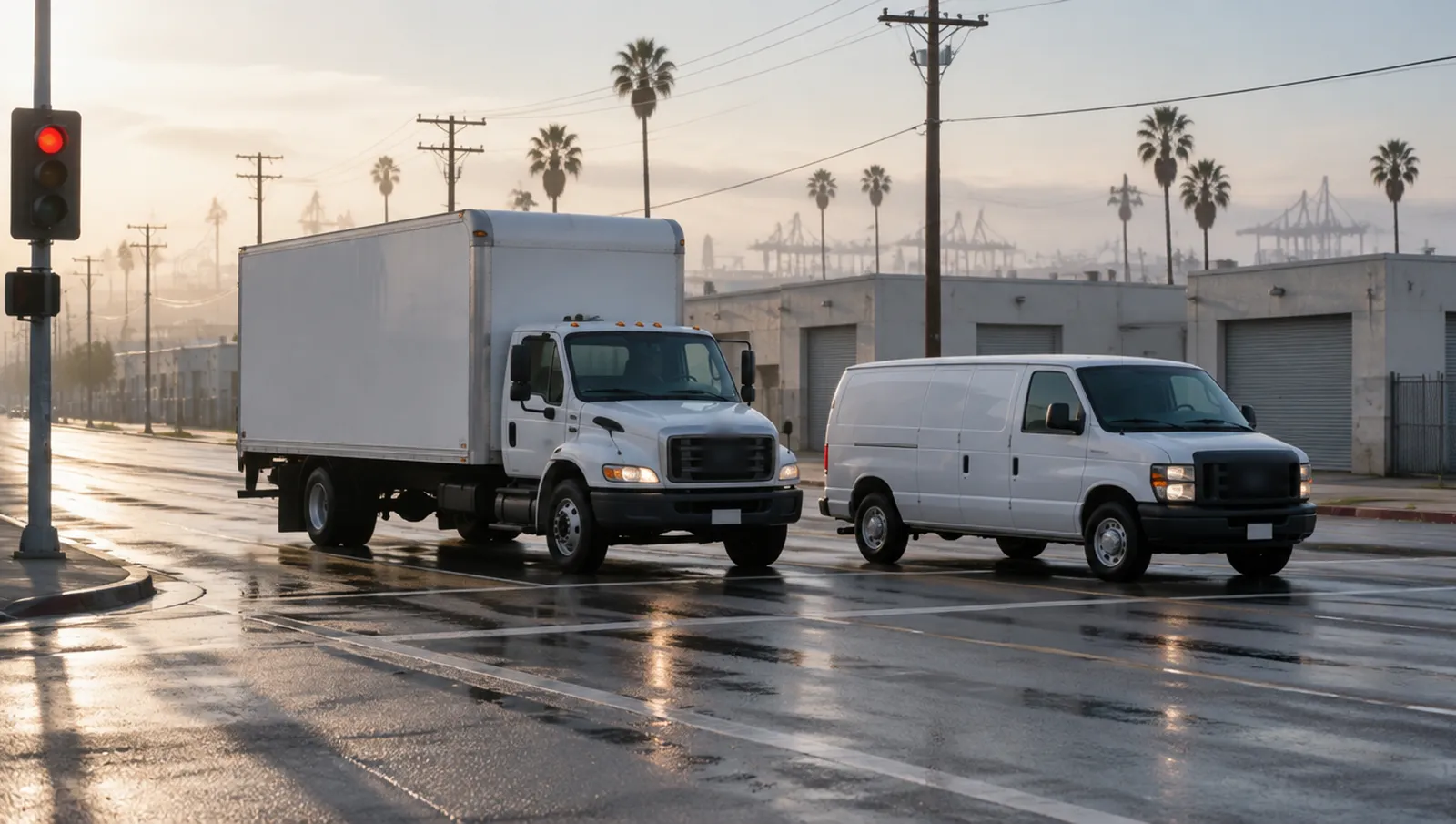
This page is for people hurt by a box truck, a moving truck, a rental truck or another straight truck in Los Angeles: drivers, passengers, cyclists and people on foot. It covers the license, hours and insurance rules, rentals, common crash patterns, and the records that prove what happened. It does not cover tractor-trailers, which are on our Los Angeles truck accident lawyer page, or delivery vans under 10,001 pounds, which are in our delivery truck and van guide. The wider picture, from employers to government trucks, is on our commercial vehicle accident lawyer page.
A box truck is a straight truck: the cab and the cargo box ride on one frame, with no trailer behind. The number that sets its rules is the gross vehicle weight rating (GVWR), which federal rules define as "the value specified by the manufacturer as the maximum loaded weight" of the vehicle (49 CFR 390.5T). The National Highway Traffic Safety Administration (NHTSA) calls trucks rated 10,001 to 26,000 pounds medium trucks. In 2024 they were 31 percent of the large trucks in fatal crashes nationwide and 44 percent of those in injury crashes, according to NHTSA's Large Trucks: 2024 Data.
Rules by truck size
| Truck | California license | Federal rules (interstate) | California rules (intrastate) | Liability floor |
|---|---|---|---|---|
| Van or small truck, 10,000 lbs or less | Class C | Not a commercial motor vehicle | Permit only if it hauls property for pay | $300,000 for a permitted carrier running only these |
| Two-axle box truck, 10,001 to 26,000 lbs | Class C | Safety rules apply; no CDL; no drug testing | Title 13 hours and records rules; motor carrier permit | $750,000 for a permitted carrier |
| Single truck over 26,000 lbs | Class B | Safety rules, CDL, drug and alcohol testing | Title 13 rules; motor carrier permit | $750,000 for a permitted carrier |
| Rental truck moving a household | Class C | Excluded as personal, unpaid moving | Excluded from the permit law | No commercial floor; read the rental papers |
Two federal lines decide most of the table. At 10,001 pounds, a truck used in interstate commerce becomes a federal commercial motor vehicle (49 CFR 390.5T). At 26,001 pounds, its driver needs a commercial driver's license, or CDL (49 CFR 383.5). A local leg of a shipment that starts or ends outside California can count as interstate. California adds its own line by axles: a single truck with three or more axles needs a Class B license even when it weighs less (Veh. Code 12804.9).
The license and testing gap
California lets a Class C license holder drive "a two-axle vehicle with a gross vehicle weight rating or gross vehicle weight of 26,000 pounds or less" (Veh. Code 12804.9(b)). That is the license class of an ordinary car. The federal commercial license starts one pound higher, so a Class C box truck driver may never have taken a commercial driving test. The truck is heavy, and the license is not.
Federal drug and alcohol testing under Part 382 applies to drivers who must hold a CDL (49 CFR 382.103). A Class C box truck driver is outside it, so no test is required after a crash. A CDL driver must be tested after any fatal crash, and after an injury or tow-away crash when cited (49 CFR 382.303). For a box truck driver, evidence of impairment starts with the police investigation: the officer's observations, any breath or blood test, and the report.
California's Employer Pull Notice program sends an employer a driver's later convictions, accidents and license suspensions. It is required for drivers of vehicles that need a Class A or Class B license or a Class C license with certain endorsements (Veh. Code 1808.1(k)). An ordinary Class C box truck driver is outside that requirement. What the company checked is a question for its own files. It matters for negligent entrustment, meaning the company's own fault in handing a truck to a driver it should have known was unsafe, which our guide to suing the company explains.
Some federal rules still reach the driver. An interstate box truck driver must be medically certified (49 CFR 391.41), and the federal definition of employee covers "an independent contractor while in the course of operating a commercial motor vehicle" (49 CFR 390.5T). Calling the driver a contractor does not take the truck outside the safety rules.
Hours and time records
A local box truck driver may keep no logbook at all, and the rules allow it. Federal rules excuse a non-CDL driver who stays within 150 air miles of the work reporting location, returns there at the end of each shift, and does not drive after the 14th hour on duty, or the 16th hour on two days in seven (49 CFR 395.1(e)(2)). The trade is a time record. The carrier must keep, for six months, the time the driver reported, the total hours on duty and the time the driver was released.
Inside California, a commercially used truck over 10,000 pounds is among the motortrucks the California Highway Patrol (CHP) regulates under Veh. Code 34500(j), which brings it under Title 13 of the California Code of Regulations (13 CCR 1200). Intrastate truck drivers may not drive more than 12 hours after 10 hours off, after the 16th hour on duty, or after 80 hours in 8 days (13 CCR 1212.5). Since January 1, 2024, carriers must use electronic logging devices unless an exception applies (13 CCR 1213). Drivers within 100 air miles who are released within 12 hours trade the log for six months of time records (13 CCR 1212(e)).
Insurance behind a box truck
The required coverage depends on what the company does, not on the size of the box. California treats any business that runs a two-axle truck over 10,000 pounds commercially as a motor carrier of property (Veh. Code 34601). It may not operate without a DMV motor carrier permit (Veh. Code 34620). It must carry at least a $750,000 combined single limit, meaning one amount of coverage for all injuries and property damage in a crash (Veh. Code 34631.5). A carrier that runs only vehicles under 10,000 pounds needs $300,000. Licensed household moving companies are carved out of this permit law and regulated separately, so a moving company's truck starts from a different set of papers.
The federal floor is narrower. It is $750,000 for for-hire carriers hauling other people's property in interstate commerce in vehicles rated 10,001 pounds or more (49 CFR 387.9), and the subpart applies only to for-hire and hazardous materials carriers (49 CFR 387.3). A private company hauling its own goods has no federal minimum. The CHP's permit FAQ adds that a carrier "solely engaged in interstate or foreign transportation of property" does not need the California permit. For a company in that gap, its coverage is whatever it bought, so we get the policy itself.
Every figure here is a floor, not a ceiling, and other policies can also apply. Our guide to whose insurance pays walks through the order of coverage and what to do when a company will not say who insures it.
Rental and moving trucks
A rental box truck usually shows the rental company's name, not the user's. A company renting a truck for 30 days or less may display the lessor's name and USDOT number instead of its own, if the rental agreement names the renting company and its address and states that the lessor "cooperates with all Federal, State, and local law enforcement officials nationwide to provide the identity of customers who operate this rental or leased CMV" (49 CFR 390.21T(e)). California has the same 30-day rule (Veh. Code 27900(b)). The name on the side may belong to the rental company, and the agreement in the cab identifies who was using the truck.
Owning the truck does not make the rental company liable. The Graves Amendment bars liability against a rental or leasing business "by reason of being the owner of the vehicle," as long as "there is no negligence or criminal wrongdoing on the part of the owner" (49 U.S.C. 30106). In Tavares v. Zipcar, Inc., decided January 30, 2026, the Court of Appeal held that it overrides California's owner-liability statute, Veh. Code 17150, for rental and leasing companies (opinion).
The statute's exception keeps open a claim built on the rental company's own conduct: a brake it should have repaired, a defect it rented out anyway, or a rental to an unlicensed driver, which Veh. Code 14608 forbids. The Tavares court found no duty on the theories raised there, about screening an app-based renter for intoxication, so each theory against a lessor stands on its own facts.
Who rented the truck changes the rest. A business renting a box truck for its work is the motor carrier, and it may answer for its employee's driving. When a person rents a truck to move house, federal rules exclude "the occasional transportation of personal property by individuals not for compensation nor in the furtherance of a commercial enterprise" (49 CFR 390.3T(f)(3)). California's permit law excludes "two-axle daily rental trucks" under 26,001 pounds "when operated in noncommercial use" (Veh. Code 34601(c)(2)(F)). The CHP truck supplement codes such a truck as not in commerce when it is "rented and operated by a private individual," according to the San Diego Police Department's collision manual.
For a private renter, the documents decide which insurance answers: the rental contract, any liability protection bought at the counter, and the renter's own auto policy. The California Department of Insurance warns that "not every auto insurance policy automatically provides coverage for rental vehicles," and that some policies cover a rental only as a substitute while the insured car is being repaired (Department of Insurance, October 16, 2023). We get the rental agreement and each policy before telling you which one applies.
Common box truck crashes
Backing is the first pattern. A box truck driver cannot see through the cargo box, so reversing depends on mirrors, a camera or a spotter. California law forbids backing a vehicle on a highway "until such movement can be made with reasonable safety" (Veh. Code 22106). A driver who reversed out of an alley or a loading dock without a working camera or a spotter has a hard question to answer.
Wide right turns are the second. The driver swings left to clear the corner, a car or cyclist moves into the space on the right, and the truck turns across it. Where a cyclist was hit, our Los Angeles bicycle accident lawyer page covers the rest.
Height and cargo cause the next group. California caps vehicle and load height at 14 feet (Veh. Code 35250), and a truck that strikes a bridge, a sign or an overhang can drop debris into traffic. Federal rules require cargo to be "properly distributed and adequately secured," and doors and tailgates to be secured, before a commercial truck moves (49 CFR 392.9). A load that shifts on a turn, or a roll-up door that opens and spills it, points to whoever loaded the truck.
Rear underride happens when a car strikes the back of a high truck body and slides beneath it. For trucks under the federal safety rules, a vehicle whose rear body edge sits more than 30 inches above the ground when empty must carry a rear impact guard. The guard's bottom may be no more than 30 inches off the ground and no more than 24 inches forward of the rear (49 CFR 393.86(b)). A missing, bent or rusted guard is a maintenance fact, and we photograph it before the truck is repaired.
Records in a box truck case
The paperwork behind a box truck is thinner than behind a big rig, and some of it is short-lived. Non-CDL time records are kept six months (49 CFR 395.1(e)(2)). Driver vehicle inspection reports are kept three months (49 CFR 396.11). California maintenance records are kept one year and must include "the name of the lessor or contractor furnishing any vehicle" (13 CCR 1234(f)). The federal maintenance file must likewise name whoever furnished a vehicle the carrier does not own (49 CFR 396.3(b)).
Electronic data has no keeping rule at all. The federal event data recorder standard covers vehicles of 8,500 pounds or less (49 CFR 563.3), which leaves out a box truck, so what the engine module or a telematics service recorded depends on the manufacturer and the company's settings. For anyone else, including an injured person, California requires the registered owner's consent or a court order to download data from a manufacturer-installed recording device, apart from narrow research and repair exceptions (Veh. Code 9951(c)). For a rental truck, that request goes to the rental company as owner.
For a crash involving a truck rated 10,001 pounds or more that kills someone, sends someone from the scene for treatment, or disables a vehicle, officers complete the CHP 555D truck supplement. It records the carrier's name, address, phone and "all carrier identification numbers," according to the San Diego Police Department's collision manual. Our guide to evidence after a commercial vehicle crash covers dispatch, scanner and GPS data, and our post on the preservation letter explains the written request.
Exceptions and edge cases
- You were driving the box truck for work. An injury on the job usually starts with workers' compensation, and a claim against another company whose driver caused the crash can run alongside it. Our post on a work-related crash explains both.
- The truck was over 26,000 pounds or pulled a trailer. Big-rig rules apply, including the CDL and federal drug testing. See our Los Angeles truck accident lawyer page.
- It was a delivery van under 10,001 pounds. The federal truck rules do not reach it. See our Amazon delivery van guide and the delivery truck and van guide.
- A city, county or state agency owned the truck. A written government claim is due within six months under Gov. Code 911.2. See our government and postal vehicle guide.
- The crash was in Riverside or San Bernardino County. The law is the same, but the courthouses, the CHP division and the public fleets differ. See our Inland Empire truck accident lawyer page.
Injuries from box truck crashes
Underride, side impacts and backing crashes put force on the head, neck and spine, and on people outside a vehicle with no protection at all. Our brain injury, spinal cord injury and catastrophic injury pages explain how those injuries are proven and valued. When a box truck crash takes a life, our guide to fatal commercial vehicle crashes and our wrongful death lawyer page explain who may bring the claim.
Truck collision, concussion
Sideswiped on the freeway by a semi-truck. Settled on the eve of trial.
Rear-end crash, herniated disc
Hit at a stoplight by a texting driver on the job. Back surgery, then a real settlement.
Prior results do not guarantee a similar outcome. Every case depends on its own facts, injuries, and insurance coverage. Amounts shown are gross recoveries before attorney's fees, costs, and medical liens.
After a box truck crash
A box truck case turns on three facts: what the truck weighed, who was running it, and why it was on the road. Those facts decide the rules, the insurance floor and whether a rental company belongs in the case.
- 1Tell us what you saw
The name on the truck, any number on the door, and where it happened.
- 2We identify the company
We match the markings, rental agreement and police report to the carrier, renter, owner and each insurer.
- 3We ask for the records
Time records, inspection reports, maintenance files and engine data go into a written preservation request to each holder.
- 4You focus on treatment
We handle the adjusters and track the two-year and six-month deadlines. No fee unless we recover.
Tell us what happened. A licensed attorney reviews it, and there is no fee unless we recover.