The truck crash preservation letter Name every record. Send it to every holder.
A preservation letter asks every company holding evidence from a truck or commercial vehicle crash to keep it. Who receives it, what it names, the retention rules behind it, and what it can and cannot do.

On this page
A preservation letter is a written request, sent soon after a crash, that names specific evidence and asks each company holding it to keep it. In a truck or commercial vehicle case it goes to the motor carrier, its insurer, the driver, the vehicle's owner, and whoever has the vehicle. It does not force anyone to hand anything over. It fixes, in writing, what exists and who was told.
Preservation letter terms
Letter recipients
The letter goes to every holder separately, because each one answers only for what it has. A single letter to the driver's employer does not reach a rental company's maintenance file or a delivery network's camera server.
- The operating motor carrier. This is the company named on both sides of the cab, after the words "operated by" if another company's name also appears, under 49 CFR 390.21T. It holds the logs, the driver file, the maintenance records, and usually the telematics.
- The carrier's insurer or claims administrator. Whoever handles the claim receives a copy, so the request sits in the claim file.
- The driver. A driver keeps the current day's log and the previous seven days under 49 CFR 395.8(k)(2), and may have messages from dispatch on a personal phone.
- The owner or rental company, if different. A truck rented for 30 days or less may show the rental company's name and USDOT number instead of the operator's, under 49 CFR 390.21T(e). The rental company holds the rental agreement and its own maintenance file.
- The trailer or chassis owner. A port chassis carries its provider's name and USDOT number on the curb side or in the interchange paperwork, under 49 CFR 390.21T(g), and that provider is a separate holder.
- The delivery network. For a delivery van, the network that runs the app and the cameras is a separate holder from the company that employs the driver. Amazon's Camera Technology Notice says footage is uploaded on request only "If still available."
- The tow yard or storage lot. Whoever physically has the vehicle is asked not to release, repair, or salvage it before an inspection.
Contents of the letter
The letter names each item by system and by date range. A request for "all evidence" is easy to read narrowly. A request that names the camera system, the telematics account, and the hours of the trip is not.
- The tractor, trailer, or van in its post-crash condition, with notice before any repair, sale, or release of either unit.
- The engine control module and any event data recorder, downloaded only under an agreed protocol with both sides present.
- The driver's records of duty status and supporting documents for the trip and the days before it, including the original electronic records and the backup copy required by 49 CFR 395.22(i).
- Forward, cab, and side camera video, telematics and GPS data, and dispatch, messaging, and load documents for the trip.
- Inspection, repair, and maintenance records for each unit, daily inspection reports, and the driver qualification file.
- Post-accident drug and alcohol testing records, including any written reason a test was not given.
- The accident register entry and every accident report required by a state, an agency, or an insurer.
- For a delivery van, route data, package scans, and app records from both the delivery company and the network.
Retention rules behind the letter
Federal rules set minimum keeping periods for some of these records and none for others. These are floors from the Federal Motor Carrier Safety Regulations, current eCFR text up to date as of September 29, 2026; a carrier may keep any record longer.
| Record | Minimum period | Regulation |
|---|---|---|
| Driver logs and supporting documents | 6 months from receipt | 49 CFR 395.8(k)(1) |
| Backup copy of ELD records | 6 months, on a separate device | 49 CFR 395.22(i)(1) |
| Driver vehicle inspection reports | 3 months | 49 CFR 396.11(a)(4) |
| Inspection, repair, and maintenance records | 1 year, plus 6 months after the vehicle leaves the carrier | 49 CFR 396.3(c) |
| Accident register and accident reports | 3 years after each accident | 49 CFR 390.15(b) |
| Driver qualification file | Employment plus 3 years | 49 CFR 391.51(c) |
| Positive tests and refusals | 5 years | 49 CFR 382.401(b)(1) |
| Negative tests | 1 year | 49 CFR 382.401(b)(3) |
| Engine data, telematics, camera video | No rule | Company or vendor settings |
The sources, in order: 49 CFR 395.8, 395.22, 396.11, 396.3, 390.15, 391.51, and 382.401. California's own periods for carriers that stay inside the state, and the electronic data that no rule covers, are in our guide to evidence after a commercial vehicle crash.
Effects of the letter
The letter creates a record of notice. California juries can be instructed on destroyed evidence under CACI No. 204, which reads in full: "You may consider whether one party intentionally concealed or destroyed evidence. If you decide that a party did so, you may decide that the evidence would have been unfavorable to that party." The instruction rests on Evidence Code section 413. A carrier that overwrites video before anyone asked has an ordinary business explanation; one that overwrites it after a letter named the system and the dates has a harder one.
The same reasoning applies to discovery sanctions. Code of Civil Procedure section 2023.030(f) bars sanctions, absent exceptional circumstances, for electronic data lost through "the routine, good faith operation of an electronic information system," and says that protection does not "alter any obligation to preserve discoverable information." In our view, a letter that names each system is the clearest way to show the holder knew what to keep.
What the letter does not do matters as much:
- It does not make anyone produce evidence. Production comes later, by agreement or through discovery, the formal exchange of evidence in a lawsuit.
- It does not open the black box. Under Vehicle Code section 9951, data on a manufacturer-installed recording device may be downloaded by someone other than the registered owner only with the owner's consent, a court order, or a narrow research or repair exception.
- It does not extend any deadline. An injury lawsuit must be filed within two years under Code of Civil Procedure section 335.1, and a claim against a public entity must be presented within six months under Government Code section 911.2.
- It does not bind a bystander. A letter to a store or a neighbor with a camera is a request; no rule requires them to keep video.
- It does not decide the jury instruction. The Directions for Use say CACI No. 204 "should be given only if there is evidence of suppression."
Post-crash testing records
Post-accident testing is decided before anyone hires a lawyer, so the letter asks for the records of it. Under 49 CFR 382.303, the employer of a driver who needs a commercial license must test after any crash with a death. After a crash with an injury treated away from the scene, or a vehicle towed away, it must test only if the driver is cited. If the alcohol test is not given within two hours, the employer must write down why; it stops trying at eight hours. For drugs, the limit is 32 hours.
Vans and box trucks
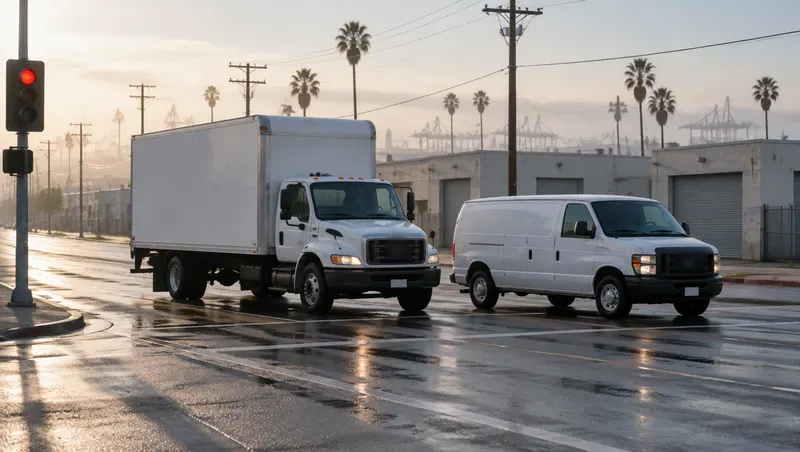
The letter changes with the vehicle. A van of 10,000 pounds or less is outside the federal safety rules, so there may be no federal log at all; the letter names the company's GPS, phone records, timesheets, and delivery scans instead. A box truck under 26,001 pounds needs no commercial license, so its driver is outside federal drug testing. A rental box truck adds the rental company as a recipient. Our guides to box truck accidents and Amazon delivery van accidents cover those vehicles.
Exceptions to the usual letter
- A city, county, or state vehicle. The letter is the same, but the six-month claim under Government Code section 911.2 runs alongside it. Our government and postal vehicle guide covers the claim.
- The truck is already repaired. The case is not over. Repair invoices, parts orders, and the shop's photographs become the record of the damage, and the carrier's maintenance file still exists.
- Your own evidence. The same rules apply to injured people. In Williams v. Russ (2008) 167 Cal.App.4th 1215, the Court of Appeal affirmed dismissal of a plaintiff's case after he let his own files be destroyed. Keep your photos, your phone, and your vehicle until it has been documented.
- The logs are past six months. The letter still goes out. Maintenance records, the accident register, the driver file, and testing records run longer.
A truck case result
The truck case in our results came out of a freeway sideswipe by a semi-truck, where the client suffered a concussion and the first offer was $100,000. The case settled on the eve of trial for $6,300,000. Truck files turn on what can be proved about the carrier and the driver, and much of that proof is in records with a keeping period.
- First offer
$100,000Recovered$6,300,000
Prior results do not guarantee a similar outcome. Every case depends on its own facts, injuries, and insurance coverage. Amounts shown are gross recoveries before attorney's fees, costs, and medical liens.
All case resultsQuestions about the preservation letter
What is a preservation letter?
Who should receive a preservation letter after a truck crash?
How long does a trucking company have to keep the driver's logs?
Is the truck's black box data saved automatically?
What happens if the trucking company destroys evidence after getting the letter?
Does a preservation letter make the company give me the evidence?
Next steps after a truck crash
A preservation letter works when it is specific and reaches every holder, and both depend on knowing who the holders are. The useful step today is a list: the carrier name and USDOT number on the door, the trailer number, any rental company name, the tow company, and the responding agency. Our find the company behind the vehicle tool turns a USDOT number into the company on record.
Our evidence guide lists every record and its keeping period, our commercial vehicle accident lawyer page covers the whole claim, and our Los Angeles truck accident lawyer page covers big-rig cases. There is no fee unless we recover.