 Written and reviewed by Josh Kohanim, Esq., California Bar No. 328609 · Reviewed
In this guide
This page is for people hurt, and families of people killed, when a container truck strikes them in the harbor area, on the 710 or the 110, or on the streets around Wilmington, San Pedro, Carson and Long Beach. It covers who is who in a container move, the Port's registration and insurance rules, the chassis, the load, and brokers. It does not cover a drayage driver's own wage or workers' compensation claim. The whole claim is on our Los Angeles truck accident lawyer page, and every vehicle driven for a business is on our Los Angeles commercial vehicle accident lawyer page.
Drayage and its parties
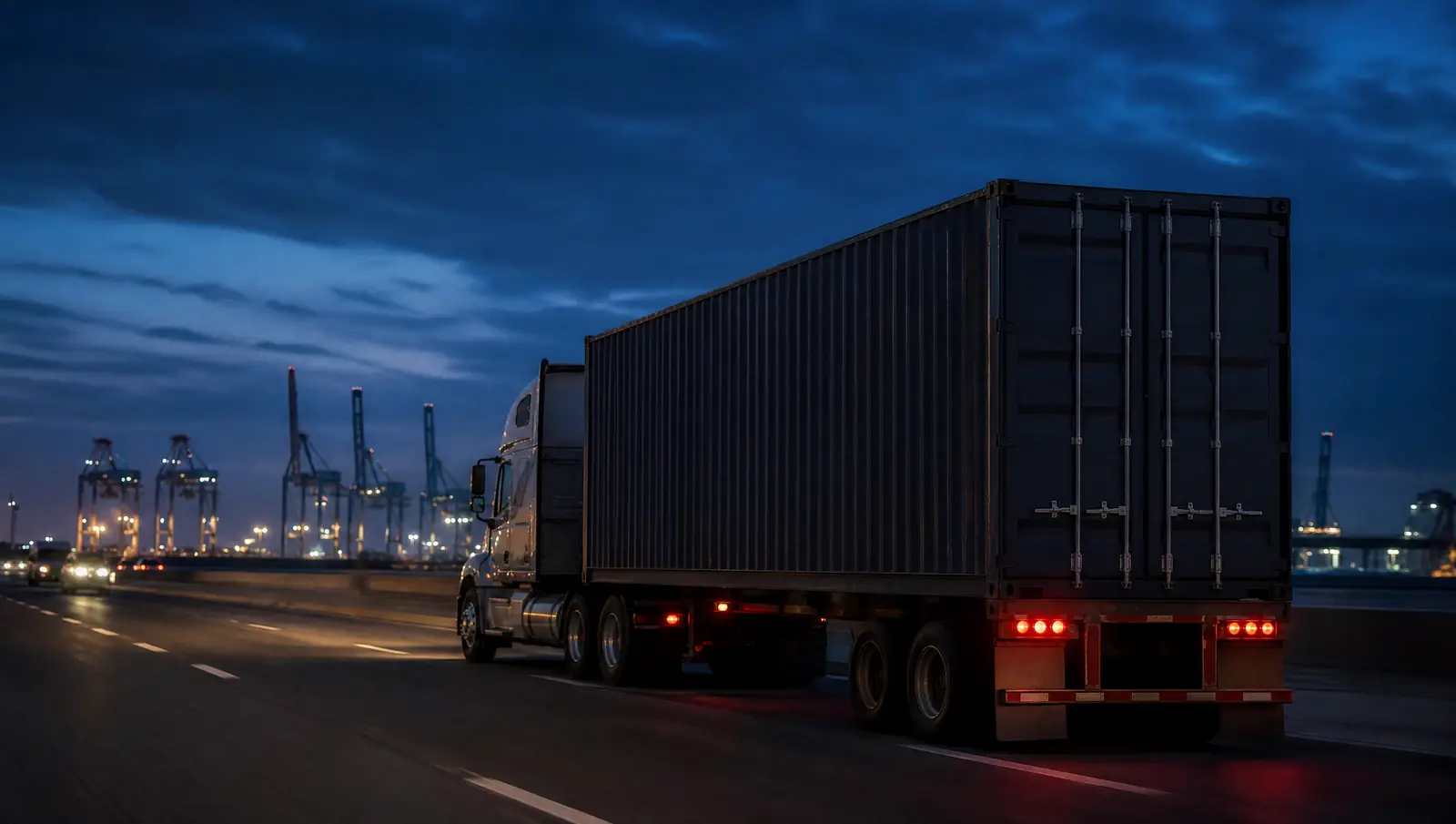
Drayage is the short truck move that takes an ocean container between a marine terminal and a nearby warehouse, railyard or customer. The container sits on a chassis, the wheeled steel frame that turns a box into a trailer, and the chassis is often leased from a pool rather than owned by the trucking company. The trucking company holding the operating authority, the federal license to haul for hire, is the licensed motor carrier. The company that owns the goods inside is the beneficial cargo owner.
None of those roles has to be the same business, and often no two of them are. That is the structural fact of a port case. The driver may own the tractor and lease it to a carrier that has three trucks. The box belongs to an importer in another state, the chassis is maintained by a pool operator, and the terminal is run by a global shipping line.
- 10,239,318TEUs (twenty-foot container units) at the Port of Los Angeles in 2025Port of Los Angeles
- 9,881,595TEUs at the Port of Long Beach in 2025, a recordContainer News, January 18, 2026
- 25cargo terminals at the Port of Los Angeles, seven of them container terminalsPort of Los Angeles
- 26 yearsas the number one container port in the Western HemispherePort of Los Angeles
The Los Angeles figures come from the Port's container statistics and facts and figures pages. The Port puts its 2025 market share at 17 percent of containerized waterborne trade handled by United States seaports, and the San Pedro Bay complex of Los Angeles and Long Beach at 31 percent. The Long Beach total is the 2025 record reported by Container News. Every one of those boxes that does not leave by rail leaves on a truck.
Port truck weights
The California Transportation Commission assessed the state's priority freight corridors under Senate Bill 671 in 2023. It treated Interstate 710 as the segment connecting Interstate 5 to the ports of Los Angeles and Long Beach. It treated Interstate 110 as the segment connecting Interstate 10 to the same ports, with State Route 47 linking both.
Around the terminals, the streets carry a load the rest of the county does not. The Port of Los Angeles publishes an overweight container corridor of designated City of Los Angeles, City of Long Beach and state routes. On those routes, permits allow the combined gross weight of truck, chassis, container and contents to reach 95,000 pounds with the proper equipment. Permits come from each jurisdiction the route crosses, and they do not travel with the load once it leaves the corridor. Mass is what turns a low speed mistake near a terminal gate into a serious injury.
Three owners in one rig
A container truck is three pieces of equipment, and each can belong to a different company. The motor carrier operating the tractor must show its name and USDOT number on both sides under 49 CFR 390.21T. The chassis often comes from an intermodal equipment provider, and 390.21T(g) requires each unit to identify that provider by its legal or trade name and USDOT number, on the curb side of the chassis or through the interchange paperwork. The container itself may belong to an ocean carrier or a leasing company.
| Role | What it does | What it may answer for |
|---|---|---|
| Marine terminal operator | Runs the terminal, loads the box onto the chassis | Loading, yard conditions, equipment |
| Licensed motor carrier | Holds the operating authority and the port concession | The driver, hiring, dispatch |
| Owner-operator | Owns the tractor and leases it to the carrier | Driving, the pre-trip inspection |
| Chassis provider | Supplies and maintains the chassis | Chassis tires, brakes and lights |
| Beneficial cargo owner or shipper | Owns the goods and packed the container | Weight and packing inside a sealed box |
| Freight broker, if one was used | Arranged the move with the carrier | A careless choice of carrier |
Chassis provider duties
Under 49 CFR 390.5T, an intermodal equipment provider is a company that interchanges equipment such as a chassis with a motor carrier under a written agreement, or that must maintain it by contract. 49 CFR 390.40T requires that provider to systematically inspect, repair, and maintain the equipment it offers for interchange. It must provide that equipment "in safe and proper operating condition," and it may not put equipment found to be an imminent hazard on the public highways.
Tires, brake lines and lighting on a pooled chassis are usually maintained by the pool operator, not by the carrier whose tractor pulled it that morning. When the roadside inspection or the post-crash download points at the trailer rather than the tractor, the maintenance file for that chassis unit number becomes the document that matters. The regulation sets the standard, and the facts decide who controlled the chassis and what failed.
Liability for the load
A container arrives at the terminal sealed. The driver hooks it, and in most cases never sees what is inside or how it was stacked. 49 CFR 392.9 requires the driver to confirm the cargo is distributed and secured before driving, to inspect the load again within the first 50 miles, and to re-examine it at intervals after that. Then it says those inspection rules do not apply to the driver of a sealed vehicle who has been ordered not to open it.
When a box is loaded to one end, or declared at a weight it does not hold, attention moves to the party that packed and sealed it. Proving it takes the seal record, the terminal's weight ticket, the bill of lading and the packing list, and every one of those sits with a different company. A shifting load inside a sealed container can point at the shipper as well as the carrier.
One caution applies in California. In Casarez v. Irigoyen Farms, Inc. (2025), the Court of Appeal held that federal law preempted negligence claims against a shipper that loaded a truck and the retailer that received the load. A petition asking the U.S. Supreme Court to revisit that ruling, No. 25-1421, is pending, so a claim against a cargo owner should expect a preemption fight.
Port registration and insurance
The Port of Los Angeles Clean Truck Program page states that "all trucks entering marine terminals must be on the Ports Drayage Truck Registry (PDTR)." Licensed motor carriers making regular calls at the Port's cargo terminals must also hold an approved Port concession agreement. Together, those rules mean a truck that serves Port of Los Angeles terminals is registered, and its carrier is on file with the Port.
The Port's concession agreement FAQ for the 2021 to 2026 agreement requires "a commercial auto liability policy with a combined single limit (CSL) of $1 million." The policy must be marked Any Auto, Scheduled and Hired, or All Owned and Hired, and must name the City of Los Angeles Harbor Department as an additional insured. That is above the $750,000 federal floor for a for-hire interstate carrier, and it shows what a concessionaire agreed to carry.
Those agreements were set to expire on September 30, 2026. On August 27, 2026, the Board of Harbor Commissioners adopted Resolution No. 26-10775, approving a First Amendment to the agreements. It extends the term to September 30, 2028, or 60 days after notice of a new registration system if sooner, and leaves the other terms unchanged. The Board sent it to the City Council for approval, and the Port signs it carrier by carrier. Whether a given carrier's concession was in force on the day of a crash is a question for the Port's records.
The Port also publishes a public list of its concessionaires. The August 2026 edition gives each company's name, any DBA name, its SCAC code, address, email and phone, which lets you confirm that a drayage company named in a police report serves the Port. The Port of Long Beach runs its own truck registration program.
Brokers and port customers
When a broker arranged the move, it can be a defendant. In Montgomery v. Caribe Transport II, LLC (U.S. May 14, 2026), a unanimous Supreme Court held that federal law does not preempt a claim that a broker negligently hired an unsafe motor carrier, because the claim falls within the safety exception at 49 U.S.C. section 14501(c)(2)(A). The Court left open loads brokered entirely within one state. The claim still requires proof that the broker was careless and that its choice caused the crash.
California also tracks drayage carriers that do not pay their drivers. Under Labor Code section 2810.4, the Labor Commissioner posts port drayage motor carriers with unsatisfied final judgments, tax assessments, or tax liens on a public list. A customer with 25 or more workers that uses a listed carrier becomes jointly and severally liable with it for unpaid wages, unreimbursed expenses, damages, and penalties for that work.
That liability covers what the carrier owes its drivers and the state. It gives a crash victim no claim. A listing is, at most, evidence about the carrier's finances and practices, which may matter in a claim that a broker should not have chosen that carrier. Our guide on who is liable in a truck accident covers brokers and shippers in full.
Differences in a port case
- Port property and Harbor Department vehicles. The Port of Los Angeles is a department of the City of Los Angeles. If a city vehicle or a condition of Port property is part of the crash, a written claim is due within six months under Government Code section 911.2, not two years.
- Inside the terminal gate. A collision in the yard happens on private property, so there may be no CHP report at all. The terminal's own incident file, the gate camera and the equipment interchange receipt, the gate document recording the container and chassis condition, become the record instead.
- An empty or bobtail move. When the tractor is running with no box or an empty one, there is no cargo interest and no shipper to add. The case narrows back to the driver, the carrier and the chassis.
- A three-truck carrier at the federal minimum. Much of the drayage fleet is small. If the carrier holds only the $750,000 federal minimum, the value of the case depends on the concession insurance and on finding the other parties in the move.
Truck collision, concussion
Sideswiped on the freeway by a semi-truck. Settled on the eve of trial.
Prior results do not guarantee a similar outcome. Every case depends on its own facts, injuries, and insurance coverage. Amounts shown are gross recoveries before attorney's fees, costs, and medical liens.
Requirements of a port truck case
It takes the paperwork of the move. The container number, the chassis unit number, the terminal, the bill of lading and the seal record identify every company that touched the load before the truck reached the freeway. The registry and concession records tie the tractor to a carrier, and the chassis marking ties the frame to its provider.
Those records belong to the companies being sued, and the federal rules keep some of them for only months, so we ask for them in writing at the start. If a container truck hurt you or someone in your family, there is no fee unless we recover. If the driver had been running long hours, read hours of service and driver fatigue. An impact at container weight tends to produce the injuries our Los Angeles catastrophic injury lawyer page covers, and crashes near the Long Beach terminals are also on our Long Beach truck accident lawyer page.