 Written and reviewed by Josh Kohanim, Esq., California Bar No. 328609 · Published · Reviewed
In this guide
This page is for anyone in a crash with a Waymo: riders, people on foot, on a bike or on a motorcycle, drivers of other cars, and families after a death. It covers reporting the crash, the insurance Waymo posts, the $5 million rule, your own insurer, a robotaxi that drove away, a crash you caused, sudden stops, pets, parked cars and deadlines. Fault is covered in who is liable, records in evidence after a self-driving car crash, and the rider contract in robotaxi passenger injuries. Our California self-driving car accident lawyer page covers the whole claim. Wise Law is not affiliated with Waymo or Zoox; the brand names identify the vehicles.
| Item | What the record shows | Source |
|---|---|---|
| DMV deployment permit | Waymo LLC is on the deployment list, dated as of November 21, 2025 | DMV permit holders |
| CPUC passenger authority | Waymo LLC, carrier TCP 38152, Driverless Deployment | CPUC permits issued |
| California insurance card | Starr Indemnity & Liability Company, June 1, 2026 to June 1, 2027, no limits shown | Waymo insurance cards |
| Collision reporting | 1-844-263-9885, online form, door QR codes, insurance@waymo.com | Waymo help center |
| First-responder line | 1 (877) 503-0840, also listed for collision reporting | Waymo first responders |
Reporting a crash to Waymo
Waymo's help page What to do after a collision, checked October 5, 2026, speaks to "witnesses or other involved parties." It says to call 911 if anyone is injured and to "look for our dome light signal, which indicates that the Waymo Driver is aware an event has occurred." It then lists these ways to "exchange collision information with Waymo":
- "Call us at 1-844-263-9885 to notify us of a collision"
- "Fill out a Collision form online"
- "Scan the QR code on either front door of the vehicle"
- "Contact insurance@waymo.com and/or download our insurance cards"
- "Wait for a Waymo roadside assistance representative to arrive on the scene"
The same page says: "Once you've exchanged information with us, you don't need to wait for a Waymo representative to arrive." It adds that "A member of Waymo's risk and insurance team reviews every collision to determine the necessary actions," and sends claim questions to "our Risk & Insurance team at insurance@waymo.com." Write down which channel you used, the time, any name you were given, and any reference number.
Waymo's first responders page carries a separate banner: "Emergency? Law enforcement, first responders, or collision reporting call 1 (877) 503-0840." Its California Law Enforcement Interaction Protocol (Revision June 2026) calls that number a "toll-free 24-hour telephone hotline" and asks callers for the license plate and "any location information available."
A report to Waymo also counts in the federal system. NHTSA's crash reporting order treats information from "consumer or customer reports, claims, demands, and lawsuits" as notice of a crash, according to NHTSA's Federal Register notice of May 26, 2026. A report you make can start the company's federal reporting duty if the crash meets the order's criteria.
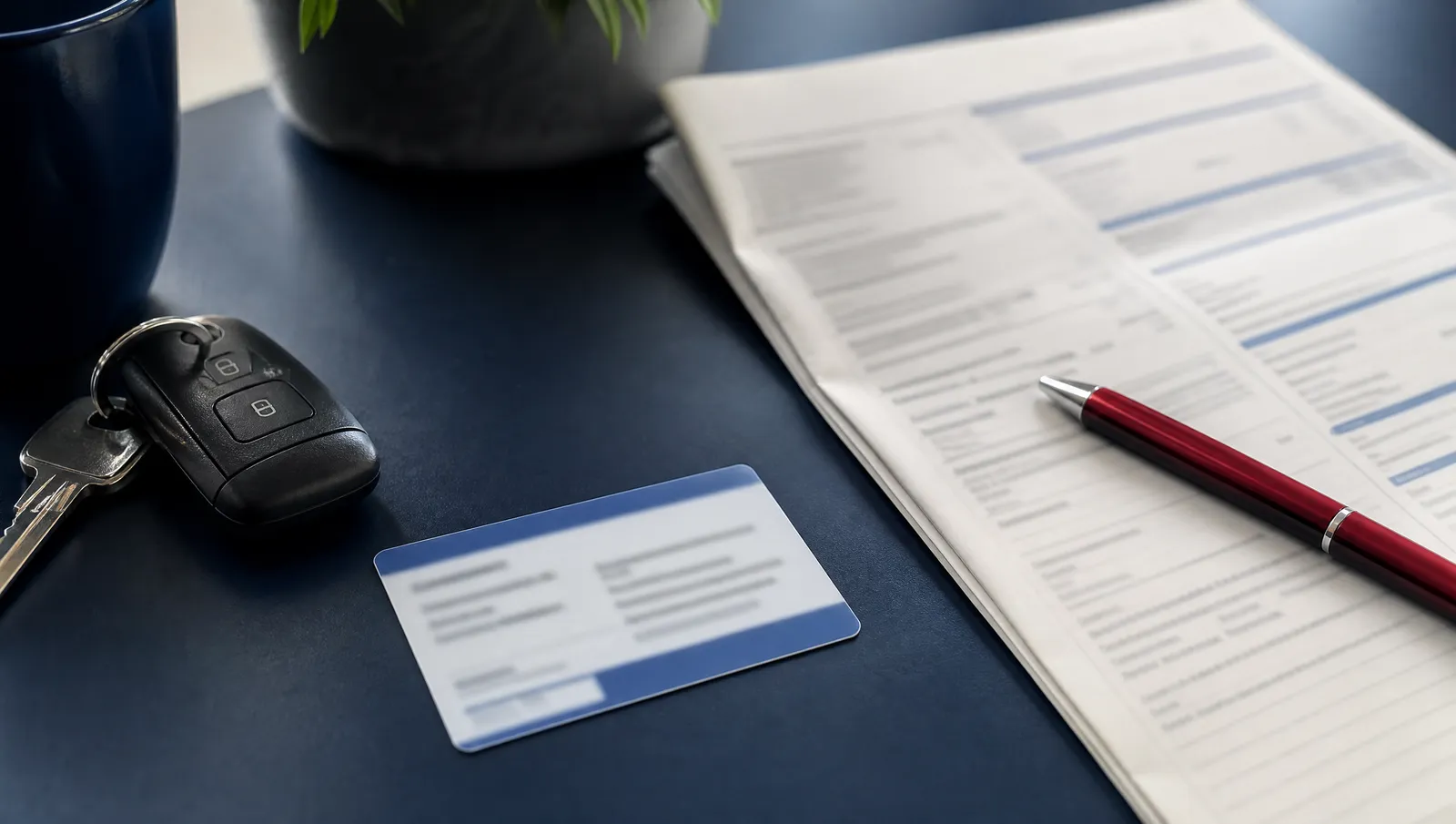
Waymo's posted insurance card
Waymo posts state insurance cards on its help center with the instruction "Please print or right click to download the card you need." The insurance cards page lists California, Arizona, Texas, Illinois, Michigan, Ohio, Georgia, Florida and Washington DC. The California card, as posted on October 5, 2026, is headed "CALIFORNIA FLEET AUTO INSURANCE IDENTIFICATION CARD" and shows the following:
- Insurer: "Starr Indemnity & Liability Company," Dallas, Texas.
- Term: effective 6/1/2026, expiration 6/1/2027.
- Insured: "Waymo LLC," Mountain View, California.
- Vehicle: "Fleet," in place of a single vehicle identification number.
- Coverage line: "THIS POLICY MEETS THE REQUIREMENTS OF § 16056 or § 16500.5 OF THE CALIFORNIA VEHICLE CODE AND IS A COMMERCIAL OR FLEET POLICY."
- Back of the card: a "CLAIMS TELEPHONE NUMBER," (833) 522-9407. The card does not say who answers it.
The card states no policy limits, and it does not say $5 million. The policy number is printed on the card; we do not republish it. Vehicle Code section 16056 sets the minimum for a policy issued or renewed since January 1, 2025: $30,000 for one person, $60,000 for two or more, and $15,000 for property. A line saying a policy meets a minimum is not a statement of its limits.
The limits come out in a lawsuit. Code of Civil Procedure section 2017.210 lets a party discover "the identity of the carrier and the nature and limits of the coverage." Waymo's California guide for police adds that "Two physical copies of vehicle owner information, vehicle registration, and proof of insurance are stored inside each autonomous vehicle."
The $5 million rule
Vehicle Code section 38750 requires the manufacturer of a self-driving car to obtain or maintain $5,000,000 in "an instrument of insurance, a surety bond, or proof of self-insurance." Subdivision (b)(3) applies to testing and subdivision (c)(3) to deployment, as amended by SB 480 effective January 1, 2026. The CPUC's AV program guidance (August 2024) says participants "must hold a $5 million insurance policy," citing the same statute. The CPUC's charter-party rules in General Order 115-G separately set $750,000 for "Any vehicle with a seating capacity of 8 persons or less."
The statute does not say per vehicle, per crash or per person. The $5 million is not a cap on damages, not a promise that any claim will be paid, and not a statement of Waymo's limits, and the law lets a manufacturer meet it with self-insurance. The $1,000,000 rideshare coverage in Public Utilities Code section 5433 is written for transportation network companies such as Uber and Lyft. In its August 14, 2026 letter approving Waymo's expanded service, the CPUC's consumer protection division wrote that "AV passenger service is not classified as a TNC under the Commission's regulations." What a claim is worth depends on the injury and on fault, not on the $5 million figure.
Your insurer or Waymo's
Two routes are open, and they can run side by side. A third-party claim goes to the company responsible for the crash or its insurer. A first-party claim goes to your own insurer under your own policy. If you carry collision coverage, your insurer can pay to repair your car, less your deductible, and then seek repayment from the responsible party. That repayment step is called subrogation. Many policies explain how the deductible is handled when the insurer recovers, so read yours or ask your agent.
The trade-off is time against money up front. Your own insurer may move faster on the car but takes the deductible first. A claim on Waymo's side avoids the deductible but runs on Waymo's review, and the person reviewing it works for Waymo's side. Medical payments coverage, if your policy includes it, is another source for medical bills. Ask for any recorded statement or release in writing and sign nothing until you know what it ends; our post on the documents an adjuster sends explains each one.
Medical coverage for riders
Riders have a separate line on Waymo's help page: "We provide limited medical coverage for our riders, regardless of who's at fault or whether you have additional coverage." The page gives no amount. It also says, for riders, "If you feel it's important, you can exchange information or document the collision. Our on site support will also document it to ensure insurance details are captured." If another driver hit the Waymo you were riding in, that driver's insurer is a second source of payment.
Waymo's terms of service (Last Updated September 29, 2026) say they bind anyone who uses the service, "including as a guest in a ride requested by another user." They require individual JAMS arbitration, allow an opt-out by email "within thirty (30) days of the date you first accepted a version of these Terms," and contain a clause titled "Two Years to Assert Claims." The terms' liability cap does not limit liability "for any personal injury or property damage to the extent caused by Waymo's negligence or a defect in our Services." Our robotaxi passenger injuries guide covers arbitration and the opt-out.
A robotaxi that drove away
Waymo's own help page says its car may leave the spot. It tells riders that, "depending on the severity of the crash and other factors, the Waymo vehicle may continue driving after a collision occurs to reach a safe spot to stop." It tells other people the car "may continue driving to reach a safe spot to stop, but look for our dome light signal." Waymo's February 17, 2026 letter to Sen. Markey says: "The ADS is designed to pull over with or without this confirmation upon detecting a collision."
Identify the car before it goes, if you safely can. Waymo's California police guide says "Each Waymo vehicle is identified by license plate, in addition to required identifiers in the jurisdiction (e.g. carrier identification symbols)," and its photos show "TCP 38152A" on the bumper corners. That is Waymo's CPUC carrier number, so it names the company, not the car; the plate names the car. Note the time to the minute, the place, the direction of travel, and any display on the rooftop dome. Then report to Waymo and to the police. A federal crash report, if one is filed later, can be matched by month, city and company in our self-driving car crash lookup.
Whether a car with nobody in it can commit a hit-and-run is unsettled. Vehicle Code sections 20001 and 20002 place their duties on "the driver" of a vehicle involved in a crash, and section 305 defines a driver as "a person who drives or is in actual physical control of a vehicle." For a car with no one in the driver's seat, section 38750(a)(4) makes the "operator" the person who "causes the autonomous technology to engage." We have found no California appellate decision applying the hit-and-run statutes to a driverless car. Since July 1, 2026 an officer may issue a Notice of Autonomous Vehicle Noncompliance to the manufacturer, which under section 38752(d) "shall not create a presumption that the autonomous vehicle is unsafe." For your injury claim, the question is who was responsible, which our who is liable guide covers. Our pages on hit-and-run accidents and hit-and-run pedestrian accidents cover cars with human drivers.
Hitting a Waymo yourself
If you hit an empty Waymo and only property is damaged, Vehicle Code section 20002(a) requires you to stop where you will not impede traffic. You must then either locate and notify the owner, or leave "in a conspicuous place on the vehicle or other property damaged a written notice giving the name and address of the driver and of the owner of the vehicle involved." With the note, the statute requires you to notify the city police or, outside a city, the Highway Patrol "without unnecessary delay." Waymo's collision line, form and door QR code are ways to reach the owner, and a photo of the note you left is a record that you complied.
If a rider inside was hurt, section 20001(a) requires you to "immediately stop the vehicle at the scene of the accident" and "fulfill the requirements of Sections 20003 and 20004." Under section 16000, a driver must report a crash to the DMV within 10 days on the form known as the SR-1 when property damage to any one person exceeds $1,000 or anyone is injured or killed. Tell your own insurer promptly, because a claim by Waymo against you is a claim against your liability coverage.
Sudden stops and chain crashes
When a robotaxi stops hard or blocks a lane, the crash can happen between other cars that never touch it. Vehicle Code section 21703 says a driver "shall not follow another vehicle more closely than is reasonable and prudent," so the driver behind is usually asked first why there was no room to stop. Fault can still be shared under California's comparative fault rules, which our page on who is at fault in a rear-end accident explains.
A robotaxi that never touched anyone can still be part of the federal record. NHTSA's order says a vehicle "is involved in a crash if it physically impacts another road user or if it contributes or is alleged to contribute (by steering, braking, acceleration, or other operational performance) to another vehicle's physical impact," per its May 26, 2026 notice. Whether a report is due depends on the order's other criteria. Whether the company is responsible for the stop depends on the facts, so report it to Waymo, keep any dashcam video, and note where the Waymo stopped and why.
Pets and parked cars
A Waymo that hits a parked car or a pet goes through the same channels: the collision line, the online form, or insurance@waymo.com, with photos and the time. For a parked car, your own collision coverage is a second route if Waymo's side is slow. For a pet, California law lists "all domestic animals" among the things a person can own under Civil Code section 655, so the claim is ordinarily presented as a property claim, supported by the veterinary records and bills. Keep the vet's notes and receipts from the first visit.
Drivers without insurance
An uninsured driver hit by a Waymo can still recover, but not everything. Civil Code section 3333.4, adopted by Proposition 213, bars non-economic damages for "pain, suffering, inconvenience, physical impairment, disfigurement, and other nonpecuniary damages" if the injured person owned a vehicle in the crash that "was not insured as required," or was the operator and "can not establish his or her financial responsibility." Medical bills, lost earnings and repair costs remain recoverable. By its terms the bar reaches owners and operators, so it does not reach a Waymo rider who neither owned nor drove a vehicle in the crash. Your own uninsured motorist coverage is a separate question.
Claim deadlines
The contract windows apply on their own terms to people who accepted them. We have found no court decision on whether a shortened window in robotaxi terms can be enforced against a rider, so the safe course is to treat the earliest date as the real one.
Company names on a claim
A claim goes to a legal entity, not a brand. The DMV lists "WAYMO LLC," the CPUC lists "Waymo LLC" with carrier number TCP 38152, and the insurance card names "Waymo LLC" as the insured. For Zoox, the DMV lists "ZOOX INC." and the CPUC lists "Zoox, Inc." with carrier number TCP 38380. Waymo's terms also cover rides requested "through a third-party website or online service ('Access Platform')," so a ride booked in another app can bring a second company's records into the claim.
A crash with a Zoox
Zoox, Inc. holds a DMV driverless testing permit for Foster City and San Francisco (DMV list updated April 3, 2026) and CPUC pilot permits. Its California First Responder Interaction Plan (updated June 2026) lists (833) 322-2277 and says riders "are not the appropriate Zoox point of contact for engaging with first responders or other third parties." It says the vehicle identification number "is visible through the window near the right-side sensor pod." Zoox's terms (Last Updated August 4, 2026) require a rider's Notice of Dispute within one year. Our Zoox accidents guide covers the rest.
Cases outside this page
- A Tesla on Autopilot or FSD hit you. That is a Level 2 driver-assist car with a human driver, and the driver's insurer comes first. See Tesla Autopilot and FSD crashes.
- A public vehicle or a road defect played a part. The six-month claim rule applies; our government and postal vehicle guide explains it.
- Someone died. The family's wrongful death claim is covered on our wrongful death lawyer page and on the self-driving car hub.
- You rode in an Uber or Lyft with a driver. Rideshare coverage follows different rules, explained in rideshare insurance coverage.
- You were walking or riding a bike. Our guide for pedestrians, cyclists and motorcyclists covers those crashes.
Next steps after a Waymo crash
A Waymo claim starts with a report through a channel Waymo publishes, the plate and the time, and a decision about your own insurer. Waymo's card names its insurer but not its limits, and the $5 million in the statute is a requirement on the manufacturer, not a measure of your claim. Our self-driving car crash checklist covers the scene. We make the reports, request the records and track every deadline, including the contract windows.
Josh Kohanim, Esq. is the firm's founder and trial attorney. Call (424) 235-7879, where Spanish-speaking staff answer the phone, or use the form. No fee unless we recover.
We deal with Waymo's insurance team and your own insurer.