 Written and reviewed by Josh Kohanim, Esq., California Bar No. 328609 · Published · Reviewed
In this guide
Waymo crash claims
This page is for riders, people on foot, on a bike or on a motorcycle, drivers of other cars, and families hurt by a Waymo in California. It covers Waymo's permits, service areas, rider terms and public crash record. Tesla and Zoox have their own pages. Wise Personal Injury & Accident Law, APC is not affiliated with Waymo LLC; the Waymo name is used only to identify the vehicle.
Waymo status in California
Waymo LLC is the company that operates the cars, and Alphabet is its majority investor, Waymo says. The California DMV decides whether a car may drive itself, and the California Public Utilities Commission (CPUC) decides whether a company may carry passengers and charge fares. The CPUC wrote on August 14, 2026 that "AV passenger service is not classified as a TNC," the category that covers Uber and Lyft.
| Record | Waymo's status | As of |
|---|---|---|
| DMV testing with a safety driver | Permit held | Sept. 17, 2026 (DMV) |
| DMV driverless testing and deployment | Approved: Jaguar I-Pace and Zeekr Ojai, all hours, rain and fog | Nov. 21, 2025 (DMV) |
| CPUC passenger permits | All four programs, including fared Driverless Deployment | Oct. 5, 2026 (CPUC) |
| Public riders | Bay Area and Los Angeles; San Diego adding riders gradually | Oct. 5, 2026 (Waymo) |
| Rider age | Account holders 18 or older | Aug. 14, 2026 (CPUC) |
The DMV's Waymo approval page lists "Jaguar I-Pace and Zeekr Ojai" and "All times of day and night." The CPUC's permits page shows Waymo as the only holder of Driverless Deployment authority, the program that allows fares. Zoox, WeRide, Nuro and Tensor hold pilot permits, which allow free rides only.
CPUC authority timeline
Waymo's fared driverless service grew in four CPUC steps, each following a DMV approval of a larger area. The CPUC's August 14, 2026 letter recounts the history and approves the latest step: "Waymo may begin fared driverless passenger service operations in the specified areas and with the Ojai vehicle platform, effective today."
| Date | CPUC action | Area added |
|---|---|---|
| Aug. 10, 2023 | Commission approved Waymo's application (Res. TL-19144) | San Francisco and parts of San Mateo County |
| Mar. 1, 2024 | Staff approved Advice Letter 0002; Commission affirmed June 20, 2024 (Res. TL-19150) | Parts of Los Angeles and more of the Peninsula |
| May 19, 2025 | Staff approved Advice Letter 0003 | More of the Peninsula, including San Jose |
| Aug. 14, 2026 | Staff approved Advice Letters 0004 and 0004-A | Parts of 18 counties and the Ojai vehicle |
Authorized and served areas
Regulators authorize far more ground than Waymo serves. Waymo's Advice Letter 0004, approved August 14, 2026, describes its approved area as parts of 18 counties: Alameda, Contra Costa, Marin, Napa, Sacramento, San Francisco, San Mateo, Santa Clara, Santa Cruz, Solano, Sonoma and Yolo in the north, and Los Angeles, Orange, Riverside, San Bernardino, San Diego and Ventura in the south. Waymo picks up the public in a much smaller area.
| Region | Authorized | Public riders, per Waymo |
|---|---|---|
| San Francisco Bay Area | Parts of ten counties, including the East Bay and North Bay | "From SF down to San Jose" |
| Los Angeles area | Parts of five counties, including Orange and Ventura | "From Santa Monica to Echo Park, and down to Inglewood" |
| San Diego | Parts of San Diego County | "Gradually adding riders" since September 1, 2026 |
| Sacramento | Parts of Sacramento and Yolo counties | None; Waymo lists Sacramento as "Up Next" |
Sources: Waymo's San Francisco and Los Angeles pages, service area list, September 1, 2026 post and rides page. A Waymo may still appear where it takes no riders, since a DMV testing permit covers "any public road within the State of California." Our regional pages cover Los Angeles, the San Francisco Bay Area and San Diego.
Waymo at California airports
The CPUC bars robotaxi service at airports "without the express authorization of the relevant airport authority." As of October 5, 2026, its permits page lists Waymo authorizations for San Francisco International (notice dated September 24, 2025), San Jose Mineta, Palo Alto, San Carlos and Santa Monica. None is posted for LAX or San Diego International, and Waymo says, "As of now, we do not offer service to LAX."
Waymo's airport help page lists curbside drop-offs at San Jose's terminals. At SFO, pickups and drop-offs are at the Rental Car Center and the Grand Hyatt, and Waymo is "offering SFO access to a limited number of riders to begin with."
Waymo vehicles and freeways
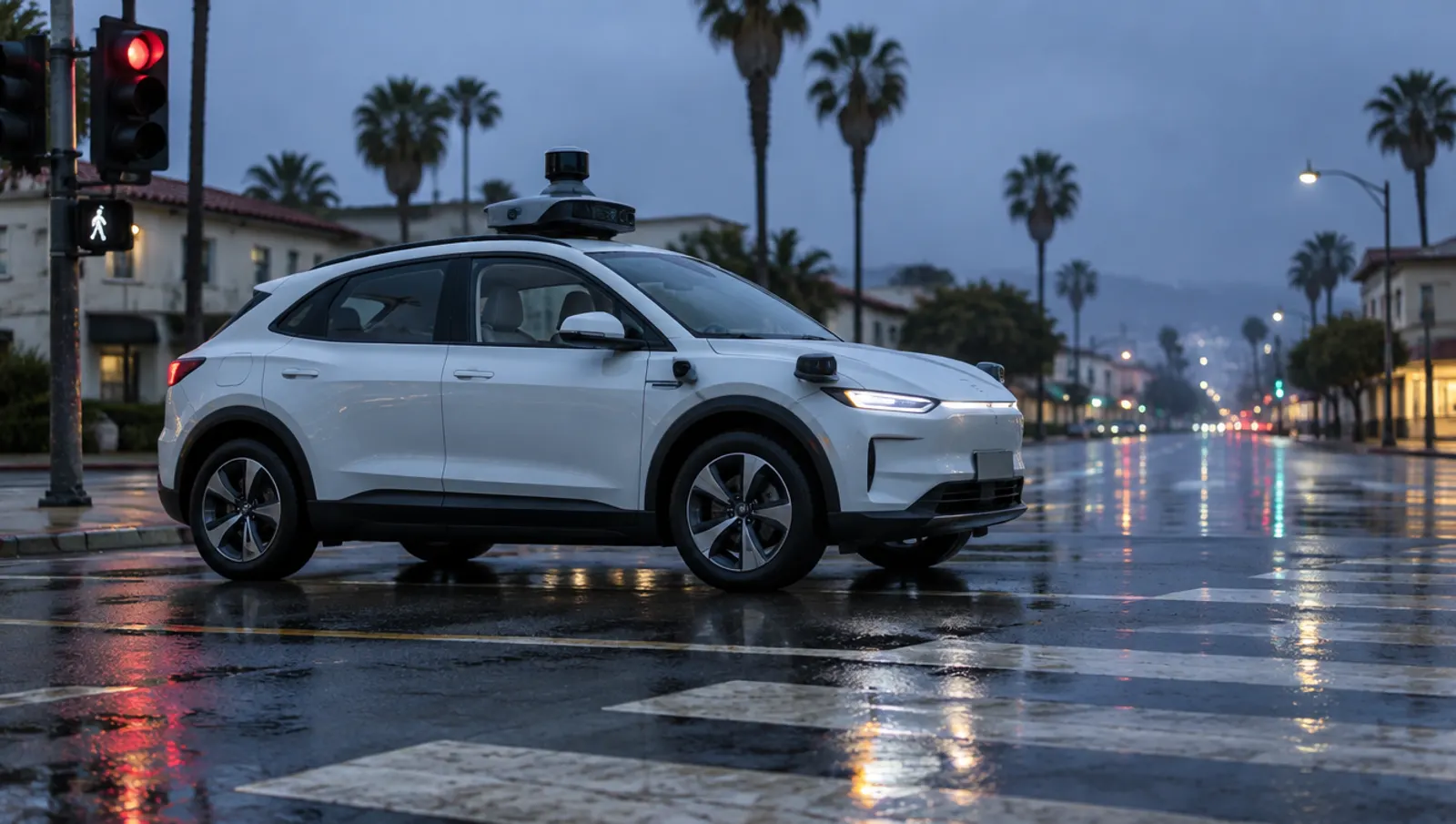
The DMV has approved two Waymo vehicles for driverless use in California, the Jaguar I-Pace and the Zeekr Ojai. The Ojai was added on November 21, 2025, and the CPUC cleared it for fared rides on August 14, 2026.
Waymo's approved operating area includes "Freeways, highways, city streets, rural roads, and other roadways" at "all speed limits," according to its CPUC filing. Riders are another matter. Waymo's freeway help page says, "Freeway access is currently limited, so not all riders can take freeway trips yet." A 2026 Waymo recall, 26E-035, addressed cars entering freeway construction zones.
Remote assistance at Waymo
In a February 17, 2026 letter to Senator Edward Markey, Waymo wrote that its remote assistance agents "do not directly control, steer, or drive the vehicle," and that the car's system "can also reject RA suggestions." Waymo described one exception, a tool that lets a specially trained U.S.-based agent "prompt the AV to move forward at 2 mph for a short distance" to leave a travel lane, which Waymo said "has never been used outside of training."
Waymo runs remote assistance from Arizona, Michigan and two cities in the Philippines, with about 70 agents on duty at a time, roughly half in the Philippines, it told the Senator. Its Event Response Team, which handles collisions and police, is U.S.-based. Waymo wrote that "Every interaction between an agent and a vehicle is meticulously logged," and a claim can ask for those logs, as our evidence guide explains.
Waymo rider terms
Waymo's Terms of Service, last updated September 29, 2026, send disputes to "binding, individual arbitration" before JAMS, except small claims, intellectual property, and sexual assault or unwelcome sexual behavior by a Waymo agent or employee. A rider may opt out by email "within thirty (30) days of the date you first accepted a version of these Terms." A claim must appear in a written Claimant Notice "within two years after such Claim arises," and the terms say they bind guests on another user's trip.
The terms' liability cap does not apply "for any personal injury or property damage to the extent caused by Waymo's negligence or a defect in our Services." People who were walking, cycling or driving another car did not accept the terms by being hit. Whether the clause, which reaches "any claims related to the use or operation of our Services," covers an account holder hurt outside a ride is untested. Our robotaxi passenger page covers arbitration in full.
Reporting a crash to Waymo
Waymo's collision help page says to call 911 first if anyone is hurt, then lists five ways to exchange information: call 1-844-263-9885, fill out its online collision form, scan the QR code on either front door, contact its insurance team or download its insurance cards, or wait for a Waymo roadside representative. Waymo says a member of its risk and insurance team "reviews every collision."
Waymo also warns that its car "may continue driving to reach a safe spot to stop," and tells people to "look for our dome light signal, which indicates that the Waymo Driver is aware an event has occurred." For riders, Waymo's rider safety page says Support will call into the car, send roadside assistance and contact emergency services, and Waymo offers "limited medical coverage for our riders, regardless of who's at fault." Our Waymo insurance and claims guide covers each step, and the crash checklist lists what to photograph and write down.
Insurance behind a Waymo
To deploy autonomous vehicles beyond testing, a manufacturer must certify under Vehicle Code section 38750(c)(3) that it will maintain "an instrument of insurance, a surety bond, or proof of self-insurance" in "an amount of five million dollars ($5,000,000)." That is a requirement on the manufacturer, not a per-crash limit, a cap on damages or a promise of coverage. Our claims guide covers the insurer named on Waymo's posted California card and how a claim moves.
Crash reports and trip volume
Waymo reports its crashes to the National Highway Traffic Safety Administration (NHTSA) under Standing General Order 2021-01, a federal crash-reporting order that covers automated driving systems. We counted Waymo's California reports in NHTSA's current public file, released September 15, 2026 and covering reports received through August 17, 2026. Keeping the latest version of each report, it holds 732 California reports from Waymo LLC for crashes from June 2025 through August 2026. Because one crash can produce several reports, we also counted NHTSA's Same Incident IDs: 732, one per report.
| Highest injury alleged by Waymo | Reports |
|---|---|
| Property damage, no injury reported | 632 |
| No injury reported | 10 |
| Minor, without hospitalization | 52 |
| Minor, with hospitalization | 20 |
| Moderate, without hospitalization | 3 |
| Moderate, with hospitalization | 5 |
| Serious, with hospitalization | 1 |
| Fatality | 0 |
| Unknown | 9 |
| Total | 732 |
The reports describe involvement, not fault. In 451 of the 732, Waymo coded its own car as stopped or parked before the crash. The rules changed on June 16, 2025, adding a property damage threshold and ending most duplicate reports, according to NHTSA notices of May 26 and July 31, 2026, so NHTSA's archive of earlier reports should not be added to these counts.
| Record | Figure | What it counts |
|---|---|---|
| NHTSA crash reports, Waymo, California | 183 (file of Sept. 15, 2026) | Reported crashes, including parked and empty cars |
| CPUC trip data, Waymo | 4,220,075 trips; 6,661,406 passengers | Fared driverless rides only |
The trip figures come from Waymo's second-quarter 2026 data, posted on the CPUC's quarterly reporting page. We do not divide one by the other. The crash reports include free rides, testing and empty cars between trips, the trip count does not, and a trip has no fixed length. Together they show scale, not a crash rate.
Limits of the crash data
NHTSA warns against treating these reports as a scoreboard. In a May 26, 2026 Federal Register notice, the agency wrote that the order "is not currently a program designed to support normalized, 'apples-to-apples' comparison scorecards of the various technologies," and that "notice under the General Order is based on allegations of a crash, rather than verified crashes." Its data dictionary adds: "Incident report data may be incomplete or unverified" and "Summary incident report data are not normalized." We do not rank Waymo against other companies or human drivers.
Waymo's own safety figures
Waymo publishes its own comparison on its Safety Impact page. Waymo says its cars drove 271.3 million rider-only miles through June 2026, including about 67.1 million in Los Angeles and 82.4 million in the San Francisco Bay Area. Comparing those miles with human crash benchmarks for surface streets, Waymo says its cars had 82 percent fewer injury-causing crashes than an average human driver over the same distance, across all its cities. Those are Waymo's figures and Waymo's method, published by the company.
Crash data and one claim
No fleet figure decides an individual case. A report shows only that Waymo reported a crash, and a fleet rate says nothing about one intersection on one day. Waymo's safety page makes the same point: "the question of fault in causing or contributing to a collision is a legal determination." Fault turns on that crash's video, sensor data, police report and witnesses. A report can still help: it confirms the company, month and city, and Waymo marked video as available in all 732 of its current California reports. Our crash lookup tool searches these reports.
NHTSA investigations of Waymo
A Preliminary Evaluation is NHTSA's first look at a possible safety defect, and an open one is not a finding of defect. As of NHTSA's investigation file of October 4, 2026, two of the three Waymo investigations are open.
| Investigation | Subject | Status |
|---|---|---|
| PE24-016 | Unexpected driving behavior, single-party crashes and possible traffic-law violations | Closed July 22, 2025, with recalls 24E-049 and 25E-034 |
| PE25-013 | Waymo cars passing stopped school buses (opened Oct. 17, 2025) | Open; recall 25E-084 |
| PE26-001 | A Waymo striking a child near a Santa Monica school (opened January 2026) | Open |
In PE26-001, NHTSA said it expects to examine the car's behavior "in school zones and neighboring areas," including "its adherence to posted speed limits," and that it "will also investigate Waymo's post-impact response." Our page on pedestrians, cyclists and motorcyclists and our child pedestrian accidents guide cover those claims.
Waymo safety recalls
Waymo filed each of these recalls of its automated driving system with NHTSA in a Part 573 safety recall report. In three, Waymo reported that every affected vehicle already had updated software when it filed.
| Recall | Problem Waymo described | Vehicles | Remedy status |
|---|---|---|---|
| 24E-049 | Collisions with poles or pole-like objects | 672 | Software and map updated |
| 25E-034 | Collisions with chains, gates and gate-like barriers | 1,212 | Software updated |
| 25E-084 | Moving on before a stopped school bus retracted its stop arm | 3,067 | Software updated |
| 26E-026 | Slowing but not stopping for a flooded lane on faster roads | 3,791 | Interim remedy; final remedy in development |
| 26E-035 | Entering freeway construction zones at speed | 3,871 | Software updates began June 16, 2026 |
For the school bus recall, Waymo reported "No collisions occurred related to this behavior" and 12 citations between September 25 and November 14, 2025.
NTSB investigations of Waymo
The National Transportation Safety Board (NTSB) has two ongoing Waymo investigations, each with preliminary information released March 3, 2026 that "is preliminary and subject to change." HWY26FH008 covers the January 23, 2026 Santa Monica crash in which an unoccupied Waymo struck a student crossing midblock in a school zone. NTSB says the car "was traveling north on 24th Street at 17 mph" before it braked. Waymo's federal crash report, 30270-13850, lists a pre-crash speed of 6 mph and says "The Waymo AV applied hard braking." Each figure belongs to its source.
HWY26FH007 covers a January 12, 2026 event in Austin, Texas. NTSB says that after the car asked remote assistance "is this a school bus with active signals?", "a remote assistance agent located in Novi, Michigan, replied 'No'" and the car passed the bus with its stop arms extended. No crash occurred. Under 49 U.S.C. section 1154(b), no part of an NTSB Board report "may be admitted into evidence or used in a civil action for damages."
December 2025 power outage
On Saturday, December 20, 2025, a PG&E outage cut power to "nearly one-third of San Francisco," Waymo wrote in a December 23, 2025 post. Its cars sent a "concentrated spike" of confirmation requests at dark signals, a backlog that "in some cases, led to response delays contributing to congestion," and Waymo "temporarily paused our service in the area." San Diego's transit agency later cited the outage in protesting Waymo's expansion, the CPUC's August 14, 2026 letter records.
SEIU complaint at the CPUC
In CPUC case C.26-03-035, filed March 27, 2026, SEIU's California State Council and three locals allege that Waymo transported minors in violation of a CPUC rule that service be "available only to be chartered by adults 18 years and older." According to an August 3, 2026 ruling, Waymo "admits that its services have been used to transport unaccompanied minors but asserts that such rides do not constitute violations of law." The docket showed the case active, with no decision, on October 5, 2026. It is an allegation, and Waymo disputes that the rides broke any rule.
Responsibility after a Waymo crash
Vehicle Code section 38750(a)(4) defines the "operator" as the person in the driver's seat or, if no one is there, the person who "causes the autonomous technology to engage." With no one in a Waymo's driver's seat, a claim may rest on Waymo LLC's negligence or a defect in its driving system, if the facts support it. Another driver who hits a Waymo answers for that driver's negligence, and a public agency may answer for a dangerous road or signal. Our guides to who is liable and California autonomous vehicle law cover each theory.
Filing deadlines
An injury or wrongful death lawsuit must generally be filed within two years under Code of Civil Procedure section 335.1. Riders bound by Waymo's terms also face a contract clause that requires a Claimant Notice within two years after a claim arises. A claim against a public agency, for example over a broken signal, must be presented within six months under Government Code section 911.2. We track each deadline from the first call.
Situations outside this page
- A Tesla on Autopilot or FSD. Our Tesla Autopilot and FSD page explains how a driver-assist crash differs from a driverless one.
- A Zoox robotaxi. Different vehicle, permits and terms; see our Zoox page.
- An Uber or Lyft with a driver. See our Uber accident page.
- A death. In Holland v. Silverscreen Healthcare (2025), the California Supreme Court held that wrongful death claimants "are not ordinarily bound by any arbitration agreement the decedent may have signed." Our wrongful death page explains who can file.
Next steps after a Waymo crash
After a Waymo crash, get medical care, report the crash to police and to Waymo, note the time to the minute and where the car stopped, and keep every photo, receipt and message. Then come the records: Waymo's video and logs, the police report and the federal crash report. Our self-driving car accident page lists every guide in this series.
Josh Kohanim, Esq. is the firm's founder and trial attorney. Call (424) 235-7879, where Spanish-speaking staff answer the phone, or use the form. No fee unless we recover.