The California three foot law and dooring The driver owed you three feet.
Two Vehicle Code sections decide most Los Angeles bicycle claims: the three foot passing rule and the rule against opening a door into traffic. Each sets a duty, the door zone works against riders, and the money comes from more than one policy.

On this page
A driver overtaking a bicycle going the same direction must pass at a safe distance of at least three feet, and where that is not possible, must slow down and pass only when it will not endanger the rider. That is Vehicle Code section 21760. Nobody may open a car door into moving traffic unless it is reasonably safe, under section 22517, and those two rules decide most Los Angeles bike claims.
Two rules for bike claims
Collisions on private property and off road trails run on different rules and are not covered here, and nothing below substitutes for someone reading the police report and the photographs in your case.
The three foot passing rule
Section 21760 names itself the Three Feet for Safety Act. Subdivision (b) requires a driver overtaking a bicycle proceeding in the same direction to pass at a safe distance that does not interfere with the safe operation of the bicycle. Subdivision (c) fixes the minimum at not less than three feet between any part of the vehicle and any part of the bicycle, and, when it is possible to do so, requires the driver to make a lane change into another available lane before passing.
Subdivision (d) covers the narrow street: when traffic or roadway conditions make three feet impossible, the driver must slow to a speed that is reasonable and prudent and may pass only when doing so will not endanger the rider. Subdivision (e) sets the fine at $35, and at $220 when the violation causes a collision resulting in bodily injury. The fine matters less than the civil consequence. A violation of a statute, proved and shown to be a substantial factor in causing the harm, requires a jury to find the driver negligent under the standard jury instruction CACI No. 418, unless the violation was excused.
Fault in a dooring
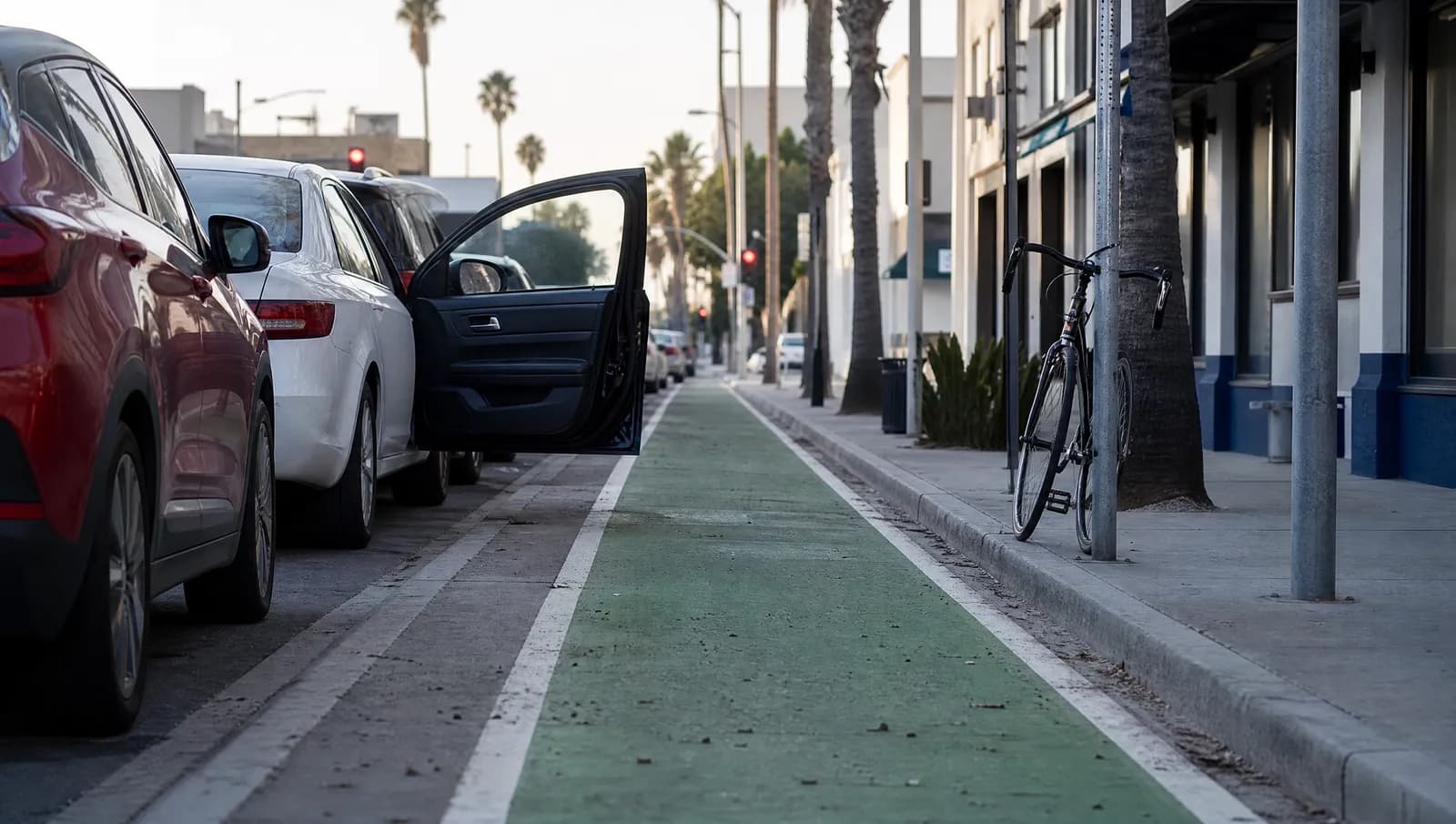
Section 22517 is one sentence: “No person shall open the door of a vehicle on the side available to moving traffic unless it is reasonably safe to do so and can be done without interfering with the movement of such traffic, nor shall any person leave a door open on the side of a vehicle available to moving traffic for a period of time longer than necessary to load or unload passengers.” It binds any person, not only the driver, which includes the rideshare passenger stepping out on the traffic side.
| Situation | The rule | Statute |
|---|---|---|
| Driver overtaking a bicycle | Safe distance, never less than three feet; change lanes when possible | Veh. Code 21760(b), (c) |
| Three feet not possible | Slow to a reasonable and prudent speed, pass only when safe | Veh. Code 21760(d) |
| Opening a car door into traffic | Only when reasonably safe and without interfering with traffic | Veh. Code 22517 |
| Riding slower than traffic | Keep right, with exceptions for hazards and narrow lanes | Veh. Code 21202(a) |
| Riding in a marked bike lane | Stay in it, with exceptions for hazards, passing, and turns | Veh. Code 21208(a) |
| A cyclist’s status on the road | Same rights and duties as the driver of a vehicle | Veh. Code 21200(a)(1) |
| Riders under 18 | Helmet required on streets, bikeways, paths, and trails | Veh. Code 21212(a) |
| Riding in darkness | Front white lamp, rear red reflector or flashing light, side and pedal reflectors | Veh. Code 21201 |
Riding outside the door zone
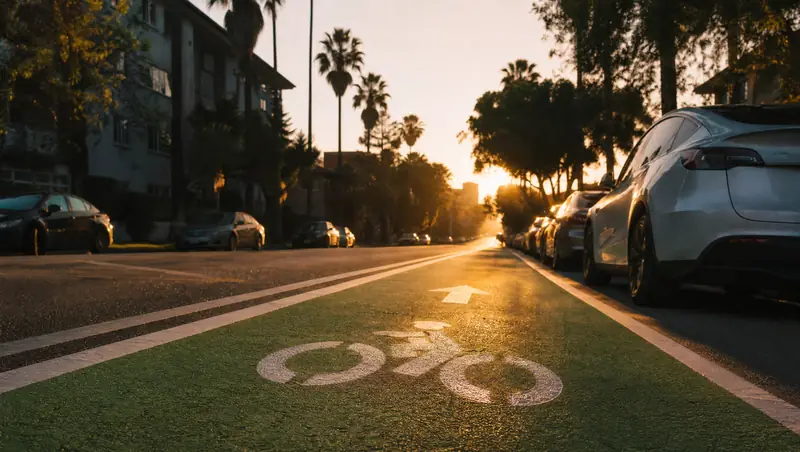
Section 21202(a) tells a rider moving slower than traffic to ride as close as practicable to the right hand curb, and then lists the exceptions. One of them, subdivision (a)(3), covers riding out when it is reasonably necessary to avoid conditions, including “fixed or moving objects, vehicles, bicycles, pedestrians, animals, surface hazards, or substandard width lanes,” that make it unsafe to continue along the right edge. A row of parked cars whose doors open into the lane is that condition.
Section 21208(a) works the same way inside a marked bike lane: stay in it, except to pass, to prepare for a left turn, to approach a right turn, or when it is reasonably necessary to leave the lane to avoid debris or other hazardous conditions. Read together, the code does not require a rider to stay in a lane whose right portion is occupied by the swing of a door. Insurers argue the first half of each statute; the exceptions are in the same sentence.
First hour photographs
In dooring and close pass cases, the physical evidence disappears within an hour. Photograph the car in the position it was parked, with the door as it was if it has not moved. Photograph the paint transfer and the dent on the door edge, the position of your bike, and the lane markings, including how much lane exists between the parked cars and the travel lane. Get the name of anyone who stopped, and note every camera within sight: businesses, doorbells, and buses all overwrite quickly.
Then get examined the same day, and report every symptom rather than the worst one. Riders tend to minimize. Handlebar impacts to the abdomen, wrist fractures, and concussions without a head strike all show up in the first week and all get argued about later if the first record is late. Our post on what to do after a motorcycle crash covers the same preservation problem for riders on two wheels with an engine.
Insurance after a bike crash
First, the driver’s liability policy. Since January 1, 2025, California’s minimum is $30,000 per person and $60,000 per accident under Vehicle Code section 16056, and an orthopedic surgery passes that before anyone discusses lost income. Second, your own auto policy, which is the coverage cyclists do not know they have. Under Insurance Code section 11580.2(b), an insured includes the named insured, the spouse, and resident relatives “while occupants of a motor vehicle or otherwise.” You do not have to be in your car for the uninsured and underinsured motorist coverage to apply, which is what makes it the answer in a hit and run.
Third, MedPay, the medical payments coverage on your auto policy, if you carry it, because it pays medical bills quickly and regardless of fault. Fourth, your health insurance, which then asserts a lien, meaning a right to be repaid out of what you recover. Civil Code section 3040 caps a health care service plan lien at the lesser of what it paid and one third of the money due to you when you have an attorney, and requires a pro rata reduction, meaning a proportional one, for your attorney fees and costs. Our post on dealing with insurance after an accident covers the conversations that come with all of it.
Exceptions to the bike crash rules
- The vehicle belongs to a public agency, or the roadway is the problem. A claim against a city, county, or transit agency must be presented in writing within six months under Government Code section 911.2, and a claim that the street itself was dangerous runs under section 835 on the same clock.
- You were not wearing a helmet. California requires helmets for riders under 18 under section 21212. For adults it is not required, and the defense will still raise it. Whether it affected the injuries is a medical question, not an automatic reduction.
- It happened after dark without lights. Section 21201 requires a front white lamp visible from 300 feet and a rear red reflector or flashing red light visible from 500 feet, among other reflectors. Missing equipment becomes a comparative fault argument, not a bar to the claim.
- The door opened and you swerved instead of hitting it. There is still a claim. The violation is opening the door into traffic, and a rider who avoids the door and goes down in the lane is harmed by the same conduct.
- The driver says you came out of nowhere. That is the standard account, and it is why the lane geometry, the camera footage, and the damage pattern matter more than either person’s memory.
Questions riders ask after a Los Angeles bike crash
What is the California three foot law?
Who is at fault in a dooring accident in California?
Can I be blamed for riding outside the bike lane?
Does my car insurance cover me when I am hit on a bicycle?
The driver drove off. Do I have a claim?
How long do I have to file a bicycle accident claim?
Key issues in a bicycle case
Distance and geometry decide it: how much room the driver left when passing, how much lane existed between the parked cars and the travel lane, and where your bike and the door ended up. The statutes give you the standard, and the photographs from the first hour are what apply it.
If you are reading this the day it happened, do three things: get examined, photograph the scene and the vehicle before anything moves, and pull out your own auto declarations page to see whether you carry uninsured motorist coverage and MedPay. Our Los Angeles bicycle accident lawyer page explains how we build these claims, our post on every California injury deadline has the dates, and there is no fee unless we recover.