Pedestrian right of way in California The driver had to yield to you.
Drivers must yield to people in marked and unmarked crosswalks, and crossing outside one does not end your claim. The Vehicle Code sets the duties, the 2023 change limited enforcement, and fault is divided by percentage when a pedestrian is hit in Los Angeles.

On this page
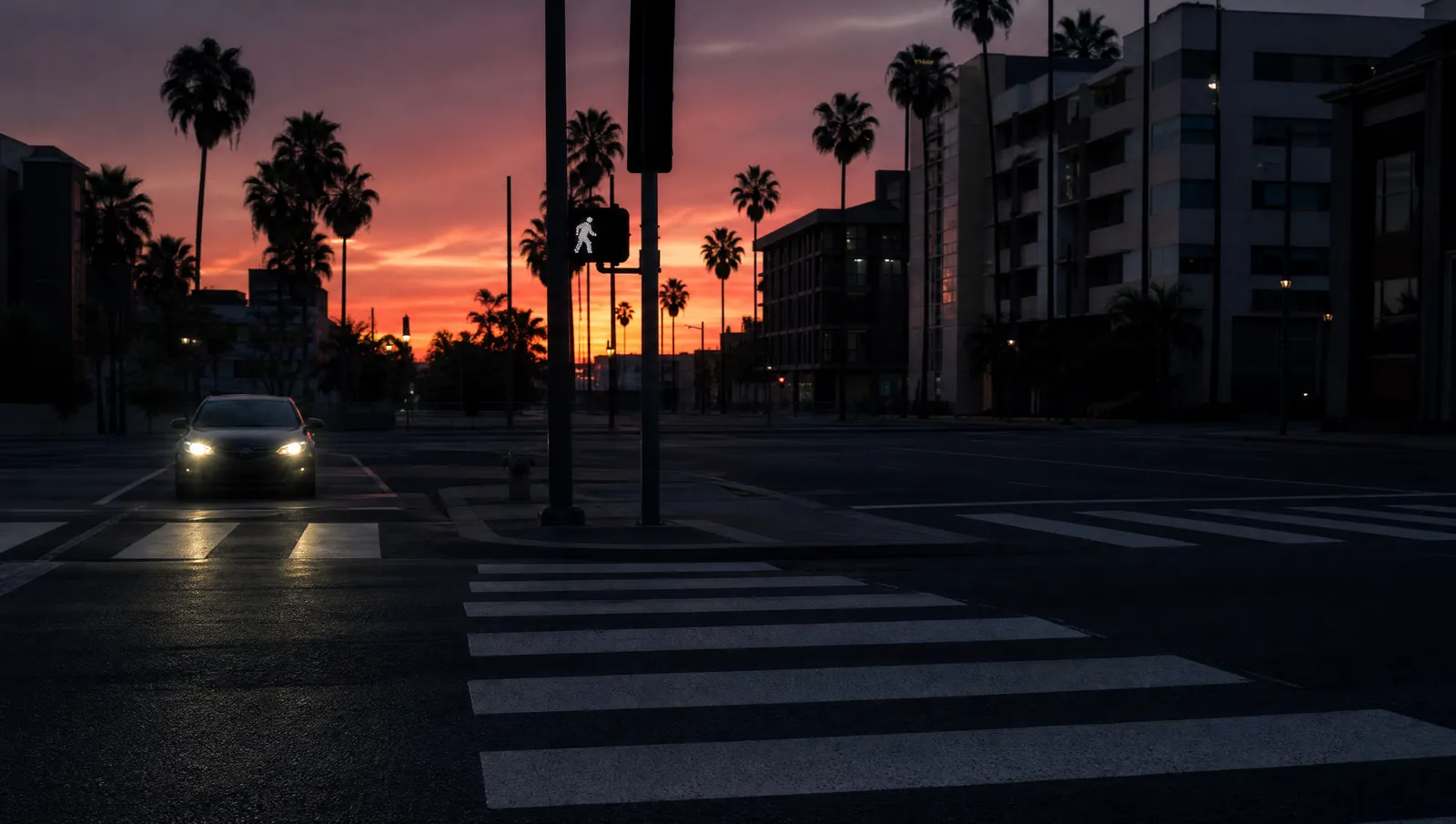
A driver must yield the right of way to a pedestrian crossing in any marked crosswalk, and in any unmarked crosswalk at an intersection, under Vehicle Code section 21950. Crossing somewhere else does not end your claim. Under comparative fault, responsibility is divided by percentage, so your crossing becomes one percentage and the driver still owes you due care. Since January 1, 2023, an officer cannot stop you for it unless a collision is immediately at risk.
Crosswalk rules
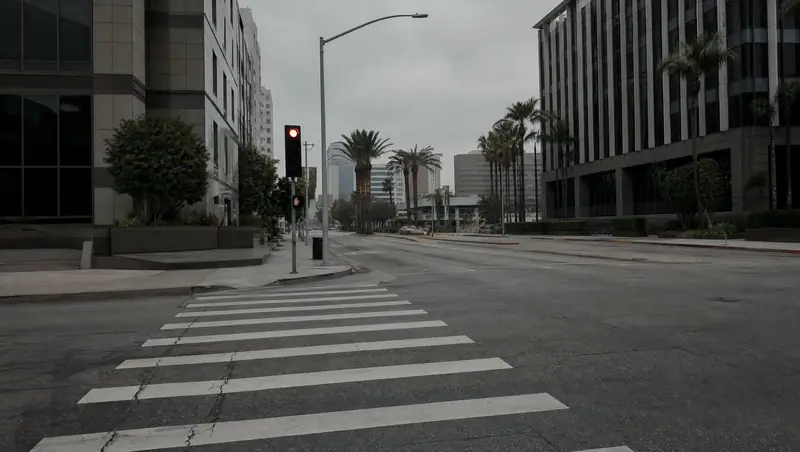
Vehicle Code section 275 defines a crosswalk as either the portion of the roadway within the prolongation or connection of the boundary lines of sidewalks at intersections where the roadways meet at approximately right angles, or any portion of a roadway distinctly marked for pedestrian crossing. The first half is the one most people do not know: an ordinary corner with no paint on the asphalt is still a crosswalk. There is no crosswalk where local authorities have posted signs prohibiting crossing. Criminal charges against the driver run separately from your claim and are not covered here.
Right of way
Subdivision (a) is the rule: “The driver of a vehicle shall yield the right-of-way to a pedestrian crossing the roadway within any marked crosswalk or within any unmarked crosswalk at an intersection.” Subdivision (c) adds a duty that survives everything else: a driver approaching a pedestrian in any crosswalk “shall exercise all due care” and must reduce speed or take other action as necessary to safeguard the pedestrian’s safety.
Subdivision (b) is the part insurers quote back at you. It says the section does not relieve a pedestrian from the duty of using due care, that no pedestrian may suddenly leave a curb and walk into the path of a vehicle so close as to constitute an immediate hazard, and that no pedestrian may unnecessarily stop or delay traffic in a crosswalk. Subdivision (d) then closes the loop: subdivision (b) does not relieve the driver of the duty to exercise due care for the safety of any pedestrian in a crosswalk. Both people have duties.
| Where you were crossing | Who yields | Statute |
|---|---|---|
| Marked crosswalk | The driver yields to you | Veh. Code 21950(a) |
| Unmarked crosswalk at an intersection | The driver yields to you | Veh. Code 21950(a) and 275(a) |
| Any crosswalk, driver approaching | Driver must slow or act to safeguard you | Veh. Code 21950(c) |
| Stepping off a curb in front of a close car | You must not, even in a crosswalk | Veh. Code 21950(b) |
| Roadway outside any crosswalk | You yield to vehicles that are an immediate hazard | Veh. Code 21954(a) |
| Outside a crosswalk, driver approaching | Driver still owes you due care | Veh. Code 21954(b) |
| Between adjacent signalized intersections | Cross in the crosswalk | Veh. Code 21955(a) |
The 2023 pedestrian law change
Section 21955 still says that between adjacent intersections controlled by signals or officers, pedestrians shall not cross except in a crosswalk. What changed is subdivision (b)(1), added by Assembly Bill 2147 and effective January 1, 2023: a peace officer “shall not stop a pedestrian for a violation of subdivision (a) unless a reasonably careful person would realize there is an immediate danger of a collision.”
The citation mostly went away and the rule of the road did not. In a civil case, a defense lawyer can still argue that crossing outside a crosswalk was negligent, and the jury can still be given the standard jury instruction CACI No. 418. That instruction tells them that if a party violated a statute and the violation was a substantial factor in causing the harm, they must find that party negligent unless the violation was excused. The absence of a ticket is not the end of the argument, in either direction.
Section 21955 is worth reading next to section 21949, where the Legislature declares that it is the policy of California that safe and convenient pedestrian travel be provided, and that all levels of government work to increase walking and reduce pedestrian deaths and injuries. That policy statement is the frame the crosswalk statutes sit inside.
Jaywalking and your claim
Comparative fault means responsibility is divided by percentage instead of being all or nothing. CACI No. 405 instructs the jury that if the defendant proves the plaintiff was negligent and that the negligence was a substantial factor in causing the harm, the plaintiff’s damages are reduced by the plaintiff’s percentage of responsibility. Under Civil Code section 1431.2, each defendant’s liability for noneconomic damages, the pain and suffering part of the claim, is several only: each pays its own share of fault and no one else’s.
In practice that means a mid block crossing does not close the file. It sets up an argument about how much of the harm belongs to the person who crossed and how much to the driver who was speeding, looking at a phone, turning left across a marked crosswalk, or driving a car whose headlights were out. The first offer in these cases is often built on the assumption that you will accept the whole percentage. It is a negotiating position, not a finding.
Possible defendants
Two facts change the case more than the crossing location. The first is who owned the vehicle. If it was a city or county vehicle, a school district van, or a transit bus, you are not on the two year clock. Government Code section 911.2 requires a written claim to the agency within six months of accrual, which usually means the date you were hurt, and missing it usually ends the case before it starts.
The second is the street itself. A claim that the intersection was unsafe, that a signal was mistimed, or that a marked crossing had been allowed to fade runs against the public entity under Government Code section 835. That section requires a dangerous condition, causation, a foreseeable risk, and either an employee’s negligent act or the entity’s actual or constructive notice in time to have fixed it. In Los Angeles, street design, signals, and crosswalk markings sit with LADOT, and the same six month clock applies.
Proof in a crosswalk case
Liability fights in pedestrian cases are usually won with footage rather than argument. Signal timing, a bus camera, a doorbell camera on the corner house, a business camera pointed at its own parking lot, and the vehicle’s own event data are all time limited, and most of them overwrite in days. The other early record is medical: get examined the same day, and report every symptom, not only the loudest one. Our post on the five steps to take after a crash covers the rest of the first hour.
- First offer
$150,000Recovered$950,000
Prior results do not guarantee a similar outcome. Every case depends on its own facts, injuries, and insurance coverage. Amounts shown are gross recoveries before attorney's fees, costs, and medical liens.
All case resultsIn our $950,000 pedestrian case, the client was struck in a crosswalk by a speeding driver, and traffic camera footage ended the liability argument rather than anything either driver or witness remembered. Footage is the reason to move in the first week even when the injuries will take months to understand.
Exceptions to the crosswalk rules
- A child was hit. CACI No. 412 tells juries that an adult must anticipate the ordinary behavior of children and must be more careful with them than with other adults. A child darting into a street is not evaluated like an adult doing the same thing.
- The driver is a government employee, or the road is the defect. Six months to present the claim, not two years. This is the most common way a strong pedestrian case is lost.
- The driver carries the minimum policy. Since January 1, 2025 that is $30,000 per person under Vehicle Code section 16056, which one ambulance ride and one surgery pass easily. Your own uninsured motorist coverage can apply even though you were walking, because under Insurance Code section 11580.2(b) the named insured and resident relatives are insureds whether or not they are occupying a vehicle.
- The driver left. A hit and run is an uninsured motorist claim on your own policy, and it has its own two year deadline to sue, agree, or formally demand arbitration.
- You were partly at fault and you know it. That is a number, not a verdict. Say it accurately to your own lawyer and to nobody else.
Questions people ask after a pedestrian crash
Does a pedestrian always have the right of way in California?
Is jaywalking still illegal in California?
Can I recover if I was hit outside a crosswalk?
What is an unmarked crosswalk?
I was hit by a city bus. Is the deadline different?
The driver had no insurance. What now?
The crosswalk law in brief
Less than most people think. It sets who had to yield, and that is one input into a fault percentage that also weighs speed, attention, lighting, turning movements, and what the footage shows. The crossing location is where the insurer starts the conversation, not where it has to end.
If you were hit, the next step is the same whether or not you were in the crosswalk: get examined today, write down where the nearby cameras are before the footage cycles, and find out whether any vehicle or agency involved is public, because that answer changes your deadline from two years to six months. Our Los Angeles pedestrian accident lawyer page explains how we build these cases, our post on what to do when the crash was not your fault covers the first week, and there is no fee unless we recover.