 Written and reviewed by Josh Kohanim, Esq., California Bar No. 328609 · Reviewed
Local differences in Beverly Hills
This page covers what is different after a pedestrian is hit in Beverly Hills. California pedestrian law in full is on our Los Angeles pedestrian accident lawyer page, and the city as a whole is on our Beverly Hills personal injury lawyer page.
Beverly Hills police reports
On a Beverly Hills street, the city police write the report. The Beverly Hills Police Department's Traffic Bureau investigates collisions on the city's streets, and the department sells copies of traffic collision reports online through LexisNexis. The city's pages do not state a fee or how long a report takes (Police Divisions and Traffic Collision Reports, Beverly Hills Police Department, checked November 9, 2026). California law requires the agency to release a collision report to people with a proper interest in it, including the drivers, anyone injured, vehicle owners, and an attorney who declares under penalty of perjury that he or she represents one of them (Vehicle Code section 20012). With your permission, we request the report for you.
CHP collision reports
The California Highway Patrol's West Los Angeles Area, 6300 Bristol Parkway, Culver City, patrols the 405 and the 10 and lists Beverly Hills among the communities it serves. A crash on those freeways produces a CHP report, not a Beverly Hills police report. To get a CHP collision report, a party of interest fills out form CHP 190 and submits it in person or by mail with a copy of a driver license or photo ID, or has the form notarized. The CHP charges $10 for a report of up to 25 pages, paid by check or money order (West Los Angeles Area and CHP 190 page, checked November 9, 2026).
Right of way in a crosswalk
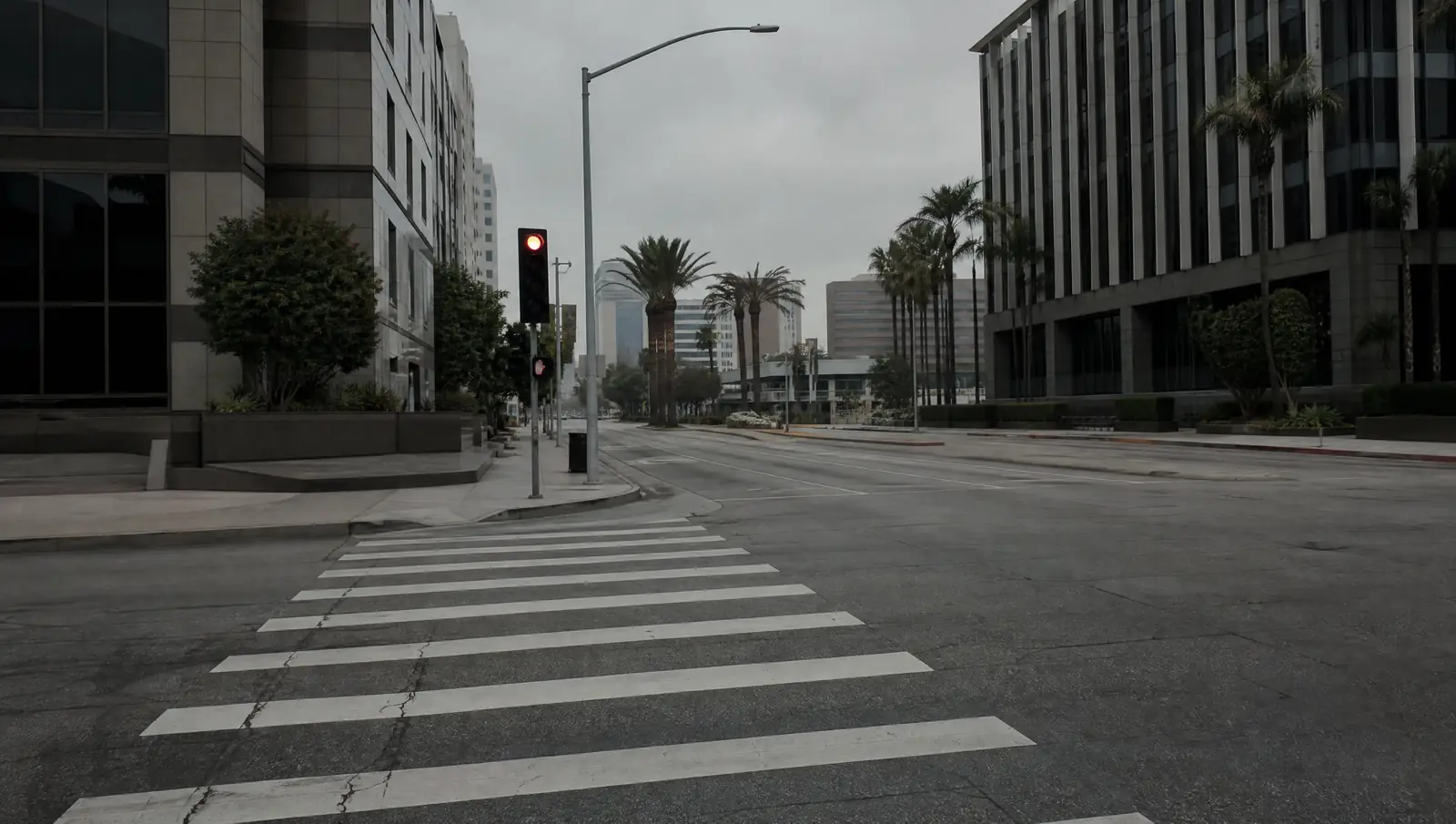
A driver must yield to a pedestrian crossing in any marked crosswalk, or in an unmarked crosswalk at an intersection, and must use all due care and slow down as needed to keep that pedestrian safe (Vehicle Code section 21950). A crosswalk does not need paint. Where two streets meet at roughly right angles, the area where the sidewalk lines would continue across the street is a crosswalk, except where those lines would run from an alley across a street or where local authorities have posted signs indicating no crossing (Vehicle Code section 275). Our guide to crosswalk accidents explains how signal phases and turning drivers are read.
Crossing outside a crosswalk
A pedestrian crossing anywhere else must yield to vehicles so close that they are an immediate hazard, but that rule does not relieve the driver of the duty to use due care for the safety of any pedestrian on the road (Vehicle Code section 21954). Crossing between two signal-controlled intersections outside a crosswalk still breaks a traffic rule (Vehicle Code section 21955). An officer may not stop a pedestrian for it unless a reasonably careful person would see an immediate danger of a collision, and neither the pedestrian nor the driver is excused from using due care. A pedestrian's right of way in a crosswalk is strong but not absolute. A pedestrian may not suddenly step off a curb into the path of a vehicle so close that it is an immediate hazard (Vehicle Code section 21950(b)).
Fault and comparative fault
A driver who fails to yield in a crosswalk is presumed negligent unless the driver has a reasonable explanation, and the pedestrian also had a duty of care (Schmitt v. Henderson (1969) 1 Cal.3d 460, as quoted in CACI No. 710). California divides fault by percentage. If the defense proves you were partly at fault, your damages are reduced by that share; the claim is not barred (Li v. Yellow Cab Co. (1975) 13 Cal.3d 804; CACI No. 405). A collision report is the investigating officer's account. In a lawsuit, the defense must prove any fault it assigns to you. Our comparative fault calculator shows how a percentage changes the numbers.
Insurance minimums
The first source of payment is usually the driver's liability insurance. California's minimum auto liability coverage is $30,000 for the injury or death of one person and $60,000 for everyone hurt or killed in one crash, plus $15,000 for property damage, for policies issued or renewed on or after January 1, 2025 (Vehicle Code 16056). A policy issued before then kept the old $15,000 and $30,000 limits until it renewed. They are floors, not a measure of what an injury is worth, so we find out early how much coverage stands behind the driver who hit you.
Your own auto policy
If the driver had no insurance or too little, your own auto policy may pay, even though you were on foot. A California auto policy with bodily injury liability coverage includes uninsured and underinsured motorist coverage (UM and UIM) unless the policyholder deleted or reduced it in writing. Umbrella and excess policies do not have to include it. Insurers must offer UM at your bodily injury limits up to $30,000 per person and $60,000 per accident (Insurance Code section 11580.2). If you are covered under an auto policy, as the policyholder, a spouse, or a relative living in the same household, that policy's uninsured motorist coverage can apply to your injuries. A relative's own policy pays only if you were covered under it. Being on foot does not by itself rule that coverage out, because the statute's definition reaches household relatives in a vehicle "or otherwise" (section 11580.2(b)).
Hit-and-run crashes
A driver involved in a crash that injures someone must stop at the scene, and leaving is a crime (Vehicle Code section 20001). When a hit-and-run driver is never identified, your uninsured motorist coverage applies only if the vehicle struck you, the crash was reported to police within 24 hours, and a sworn statement was filed with the insurer within 30 days. Those conditions come from Insurance Code section 11580.2, not from the policy, and someone else can make the report on your behalf. The uninsured motorist claim also has its own deadline: within two years of the crash, you must sue the uninsured driver, reach a written agreement with your insurer, or start arbitration by certified mail. Our hit-and-run checklist and our guide to hit-and-run pedestrian accidents cover the first days.
Dangerous public property
A public entity can be liable for an injury caused by a dangerous condition of its property, such as a crosswalk, a signal or a sidewalk, if the condition caused the injury and created a reasonably foreseeable risk of that kind of injury, and either an employee's negligent act created it or the entity had notice of it in time to protect against it (Government Code section 835). A dangerous condition is one that creates a substantial risk of injury, not a minor or trivial one, when the property is used with due care in a foreseeable way (section 830). Whether a condition qualifies is decided on the evidence, and public entities have immunities of their own. With your permission, we photograph the location and request the agency's records about it.
Claims against a public agency
A claim goes to the public entity whose employee, vehicle or property was involved, not to the city where the crash happened. A claim against the City of Beverly Hills, over a city signal, crosswalk, sidewalk or vehicle, is filed with the City Clerk's Office, 455 N. Rexford Drive, Room 290. The city's form states that claims for death or personal injury must be filed within six months (Government Code section 911.2) (City of Beverly Hills claim form, checked November 9, 2026). A claim against the State of California, including the CHP and any Caltrans claim over $12,500, goes to the Government Claims Program at the Department of General Services. The filing fee is $25 (Department of General Services and Caltrans claim pages, checked November 9, 2026). A Metro bus or train, or a County of Los Angeles vehicle, points to Metro or to the County.
Filing deadlines
Most California injury lawsuits must be filed within two years of the injury (Code of Civil Procedure section 335.1). If a city, a county, the State, a school district, a transit agency or another public entity may be responsible, a written claim must first be presented to that entity within six months after the claim accrues (Government Code section 911.2). The lawsuit against the entity then has its own deadline: six months after a written rejection notice is delivered or mailed, or two years from the date the claim accrued if no written notice is given (Government Code section 945.6). The dates in any one case should be calculated by a lawyer.
If the six months pass, a late claim application may be made within one year under Government Code section 911.4, and it is not granted automatically. Our deadline calculator can help.
Courthouse for the case
Los Angeles Superior Court Local Rule 2.3(a)(1)(A) requires an unlimited civil lawsuit for bodily injury or wrongful death to be filed in the judicial district where the incident arose. For Beverly Hills, the court's filing locator lists the Santa Monica Courthouse, 1725 Main Street, or the Beverly Hills Courthouse, 9355 Burton Way, both in the West District. Where you live does not change the district. We confirm the courthouse when the case is filed (Local Rules, Chapter 2, effective July 1, 2026, and the Filing Court Locator, both checked November 9, 2026).
Beverly Hills crash figures
In 2024, 627 people were killed or injured in crashes in Beverly Hills, 42 of them pedestrians; in 2025 the count was 499 people (SWITRS via UC Berkeley TIMS, data as of September 15, 2026; 2025 provisional).
The city's Complete Streets Plan says the number of people in Beverly Hills climbs to between 150,000 and 200,000 during the day (Complete Streets Plan, Chapter 1). Beverly Hills adopted that plan in April 2021 and keeps a Complete Streets Action Plan of priority projects; the latest is dated May 2025 (City of Beverly Hills Complete Streets page, checked November 9, 2026). These figures do not show who was at fault in any one crash.
Fatal pedestrian crashes
If a pedestrian died, the family's claim is a wrongful death claim. Most wrongful death lawsuits must be filed within two years of the date of death (Code of Civil Procedure section 335.1). If a public entity may be responsible, a written claim is due within six months after the claim accrues, usually the date of death (Government Code section 911.2). Our guide to fatal pedestrian accidents covers the death side of these cases, our fatal crash facts by city tool has year-by-year federal counts, and our Beverly Hills wrongful death page covers the death records and the family's claim.
Fees and first steps
Call us or use the form on this page, in English or Spanish. With your permission, we request the collision report, look for witnesses and camera footage near the crossing, gather your medical records and bills, find every policy that may pay, including your own uninsured motorist coverage, and present any claim against a public agency on time. What a case is worth depends on its own evidence and the coverage available, and no result is guaranteed. Our office is in Tarzana, and you do not have to come to it. No fee unless we recover. If there is no recovery, you owe no fee and no case costs.
Related pages
- Los Angeles pedestrian accident lawyer, the full picture of a California pedestrian claim.
- Guides: crosswalk accidents, hit-and-run pedestrian accidents and child pedestrian accidents.
- Tools: the deadline calculator, the comparative fault calculator and the hit-and-run checklist.
- In Beverly Hills: our car accident, bicycle accident and Uber accident pages. If someone died, see our Beverly Hills wrongful death page.
- Nearby: our Woodland Hills and Calabasas pedestrian accident pages.
Call, or send the form below. We answer in English or Spanish.
Sources cited
- Code of Civil Procedure section 335.1; Government Code sections 830, 835, 911.2, 911.4 and 945.6: California Legislative Information
- Vehicle Code sections 275, 16056, 20001, 20012, 21950, 21954 and 21955; Insurance Code section 11580.2: California Legislative Information
- Li v. Yellow Cab Co. (1975) 13 Cal.3d 804: CourtListener; CACI Nos. 405 and 710, Judicial Council of California Civil Jury Instructions (2026 edition): courts.ca.gov
- Beverly Hills Police Department: Police Divisions; Traffic Collision Reports
- California Highway Patrol: West Los Angeles Area; CHP 190
- Claims: City of Beverly Hills claim form; Department of General Services Government Claims Program; Caltrans damage claims
- Los Angeles Superior Court Local Rules, Chapter 2, and the Filing Court Locator: Local Rules; locator
- SWITRS via UC Berkeley TIMS, data as of September 15, 2026
- City of Beverly Hills: Complete Streets; Complete Streets Plan, Chapter 1