 Written and reviewed by Josh Kohanim, Esq., California Bar No. 328609 · Reviewed
In this guide
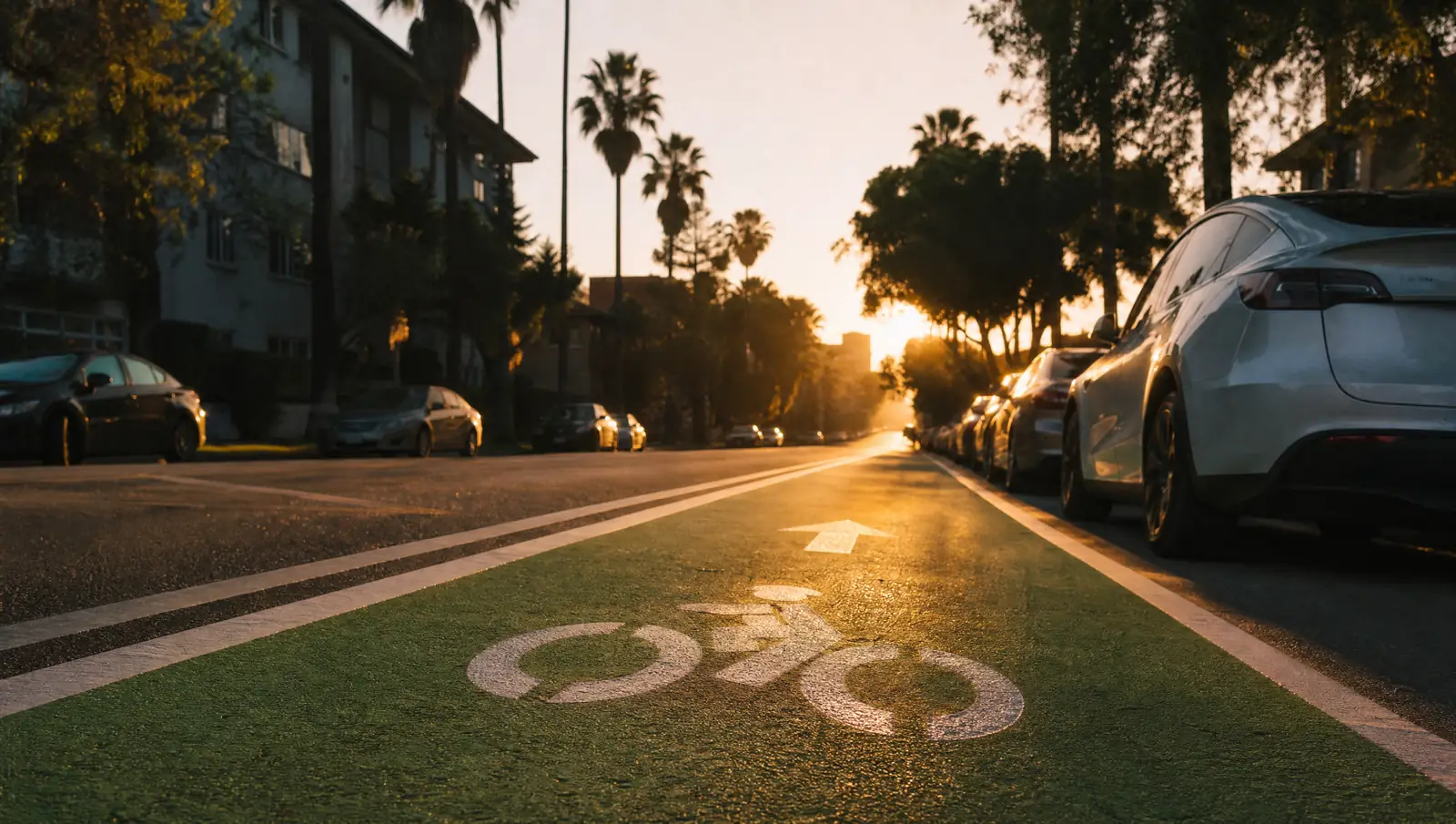
A rider hit inside or alongside a bike lane often receives a collision report that blames him for being where he was. The Vehicle Code governs the turning driver, lists four situations where a cyclist may leave a bike lane, and gives the rider what he needs to rebut that report. A crash caused by a car door is covered in our guide on dooring accidents.
Right hooks and left crosses
A right hook is a driver who passes a cyclist and then turns right across the cyclist's path, or who sits beside the cyclist at a light and turns right when it goes green. A left cross is an oncoming driver who turns left across the path of a cyclist coming the other way. Both are broadside collisions, and broadside crashes make up 34.9 percent of California's fatal and serious injury bicycle crashes according to UC Berkeley SafeTREC for 2023.
| What happened | What the driver did wrong | Section |
|---|---|---|
| Right hook after passing | Turned across the lane without merging into it | Veh. Code 21717 |
| Right hook from a stopped queue | Turned right from the through lane | Veh. Code 21717, 22100 |
| Left cross at an intersection | Failed to yield to approaching traffic | Veh. Code 21801 |
| Sideswipe while overtaking | Passed closer than three feet | Veh. Code 21760 |
| Driving or idling in the bike lane | Used the lane for something other than the three allowed purposes | Veh. Code 21209 |
| Pulled out of a driveway into the lane | Entered without yielding to approaching traffic | Veh. Code 21804 |
The merge rule
Vehicle Code section 21717 requires a driver who must cross a bicycle lane adjacent to his lane of travel to make a turn to drive into the bicycle lane before turning. The turn itself must then be made under section 22100. Section 22100(a) requires both the approach and the right turn to be made as close as practicable to the right-hand curb or edge of the roadway.
Together, the two sections describe the lawful right turn across a bike lane. The driver checks, signals, merges into the bike lane behind the cyclist, and turns from there. A driver who turned right while still in the through lane did not perform that maneuver. That is a statutory violation, and it supports negligence per se, the rule allowing a jury to presume negligence where a defendant broke a statute designed to prevent this kind of harm to this kind of person.
Section 21209 sets the outer boundary. A motor vehicle may be driven in a bike lane only to park where parking is permitted, to enter or leave the roadway, or to prepare for a turn within 200 feet of the intersection. A car that was in the lane for any other reason, including waiting for a passenger or queueing to enter a driveway, was somewhere the code did not allow.
Leaving the bike lane
The standard defense in these cases is that the rider came out of the bike lane unexpectedly. Section 21208(a) answers it. A rider moving slower than traffic must use the bike lane, with four exceptions. The rider may leave the lane to overtake and pass another bicycle, vehicle, or pedestrian within or about to enter the lane, where passing cannot be done safely inside it. He may also leave it when preparing for a left turn at an intersection or into a private road or driveway, when reasonably necessary to avoid debris or other hazardous conditions, and when approaching a place where a right turn is authorized.
Section 21208(b) adds the one duty that does fall on the rider: do not leave the lane until the movement can be made with reasonable safety, and only after an appropriate signal, where any vehicle may be affected. The question in a case like this is whether the rider looked and signaled before he left the lane. That is a narrow factual dispute, and witnesses and video can settle it.
Section 21202 carries the same four exceptions for a road with no marked lane at all, including the exception for a lane too narrow for a bicycle and a car to travel safely side by side. Our parent page on Los Angeles bicycle accident claims works through that definition and its effect on comparative fault, the rule that reduces an award by the share of responsibility assigned to the rider.
Types of bike lane
Not every stripe is the same facility. Streets and Highways Code section 890.4 defines four classes of bikeway. The class determines where a turning driver was supposed to be, what he could see, and whether a physical barrier made a merge impossible.
| Class | What it is | Miles in the Metro service area |
|---|---|---|
| Class I | A separated right of way for bicycles and pedestrians | 321 |
| Class II | A striped bike lane in the roadway, parking and crossings allowed | 984 |
| Class III | A signed or marked route shared with motorists | 553 |
| Class IV | A separated bikeway alongside the roadway, divided by posts, a barrier, or parking | 77 |
Those mileages are from LA Metro's facts at a glance, which puts 1,935 total miles of bike lanes in a 1,440 square mile service area. Most Los Angeles riding happens in a painted Class II lane, where the merge rule in section 21717 governs and where right hooks happen. On a Class IV separated bikeway the driver cannot merge, so the analysis shifts to what he could see at the crossing and whether he yielded.
Reports that blame you
- Get the signal timing. A right hook at a green often turns on whether the driver had a turn phase and how long the cyclist had been beside him.
- Fix the impact point on the car. Damage to the right front fender or the passenger door shows the bike was already alongside when the turn started.
- Measure the resting positions. Where the car stopped relative to the crosswalk, and where the bike came to rest, show how far into the turn the collision happened.
- Canvass for video the same week. Storefront, bus, and doorbell cameras on an arterial usually overwrite within about two weeks.
- Photograph the striping and any barrier. The lane class, the dashed merge zone before the intersection, and sightline obstructions are physical facts that disappear once the street is restriped.
- Ask the officer what he measured. Reports in these cases are often built from one driver's account taken while the rider was being loaded into an ambulance.
Exceptions to the merge rule
- The driver merged properly and you passed him on the right. Once a car is lawfully in the bike lane preparing to turn, passing it on the right is the rider's risk, and the case becomes difficult.
- There was no bike lane. Section 21717 applies only where a bike lane is adjacent to the driver's lane. Without one, the case runs on section 22100, the basic speed law, and ordinary care.
- You were in the driver's blind area the whole time. A rider who came up the right side of a moving line of traffic at speed will carry a share of the fault, whatever the merge rule says.
- The rider entered against a signal. A red light or a stop sign violation by the rider is a comparative fault argument that no statute about turning drivers answers.
- A parked car blocked the sightline. Vehicle Code section 22500(n) restricts stopping or parking within 20 feet of the approach side of a crosswalk, or 15 feet where a curb extension is present. Where that car was parked is worth checking against the rule.
Fault for turns across bike lanes
Usually the driver, and usually for a reason the report never names. Section 21717 required him to be in the bike lane before he turned, section 22100 required the approach itself to hug the right edge, and section 21209 gave him only three reasons to be in that lane at all. A driver who turned across a lane he never entered broke a rule written for this collision.
The next step is to preserve what proves it: the signal timing, the video on that block, the damage pattern on the car, and photographs of the striping before it changes. Our guide on e-bike accidents applies these same rules to a powered bike, and our Los Angeles car accident page covers the claim against the driver's insurance company.
When the turning vehicle was a delivery van, a box truck, or another work vehicle, the same rules decide fault and a second question opens: whether the company the driver worked for answers for the turn. A long vehicle swings wider and sees less to its right than a car, and its cameras and route data may show what the driver could see. Our guide to box truck accidents and the commercial vehicle accident page cover that side of the claim.
No fee unless we recover.